
Lisbon 9 th April
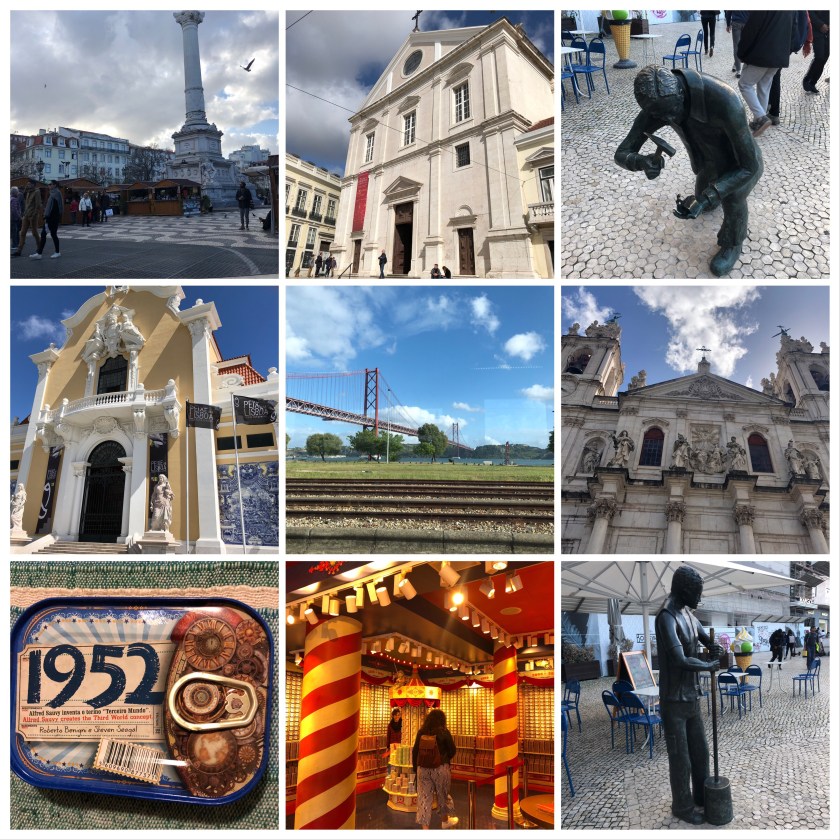
We made another abortive attempt to get going early today and then we tried to get Bill a more comfortable and smart pair of shoes. Because of his sore foot he has been wearing bright blue runners that he wears to the gym. He feels they are too showy but they feel more comfortable than his dressier shoes for walking. Unfortunately the ones that fitted were not to his taste and were no more comfy. While Irene was trying to get her glasses fixed we came across the Sardine shop. It is decked out like a lolly shop!Anne and I bought our birthday year on a sardine can. What a natty off beat present and brilliant marketing!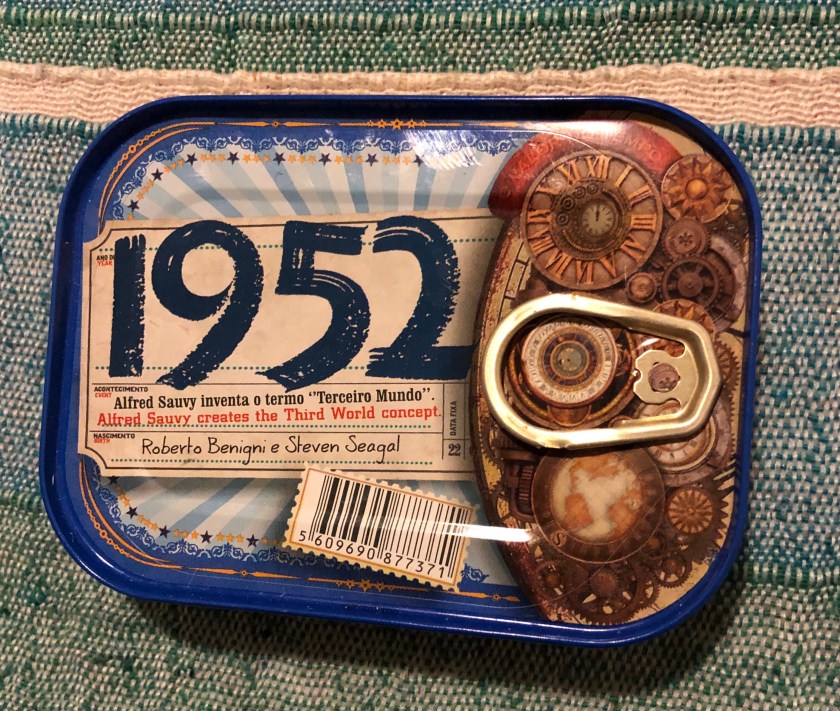

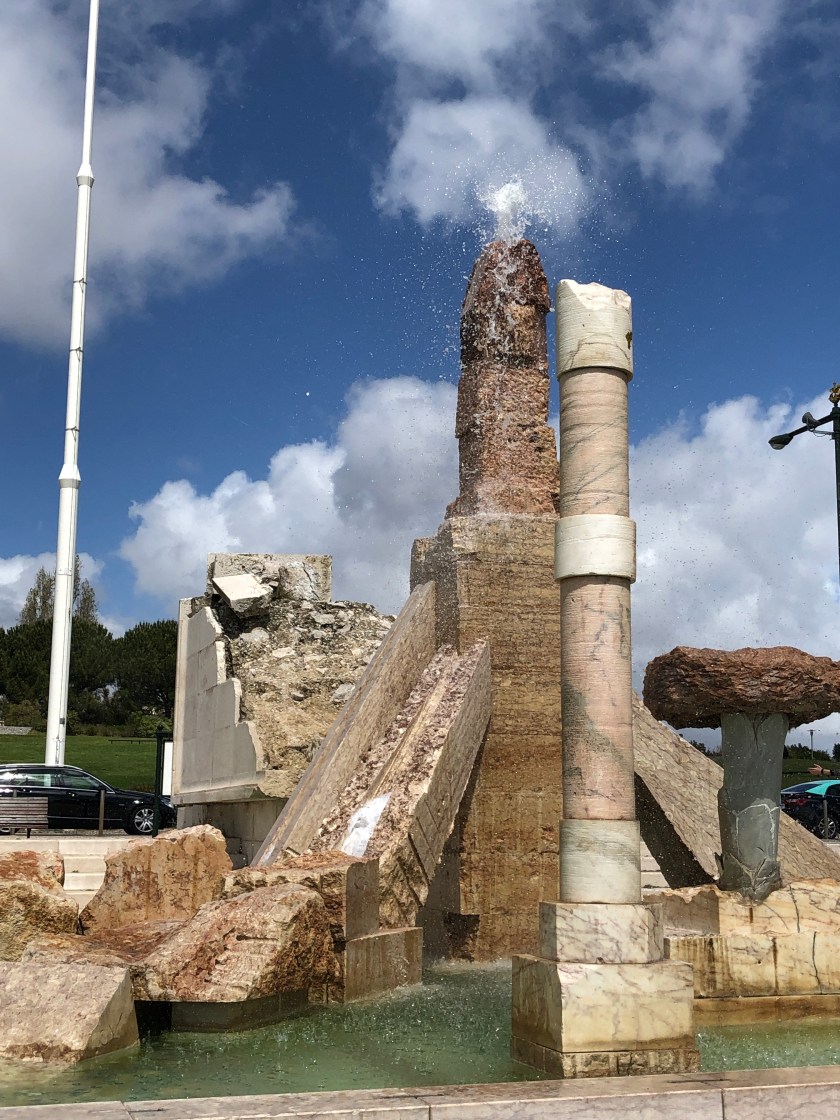
We returned to our mission of seeing more of Lisbon. We still had hop on hop off bus options so we took it again with specific sites to visit in mind. We actually absorbed more this time and stopped off at the King Edward Vll Park. It has the most magnificent view to the river and two interesting sculptures. One a fountain that looked like it was breaking down, a memorial to the earth quake Lisbon suffered and then two columns commemorating their independence from the dictatorship.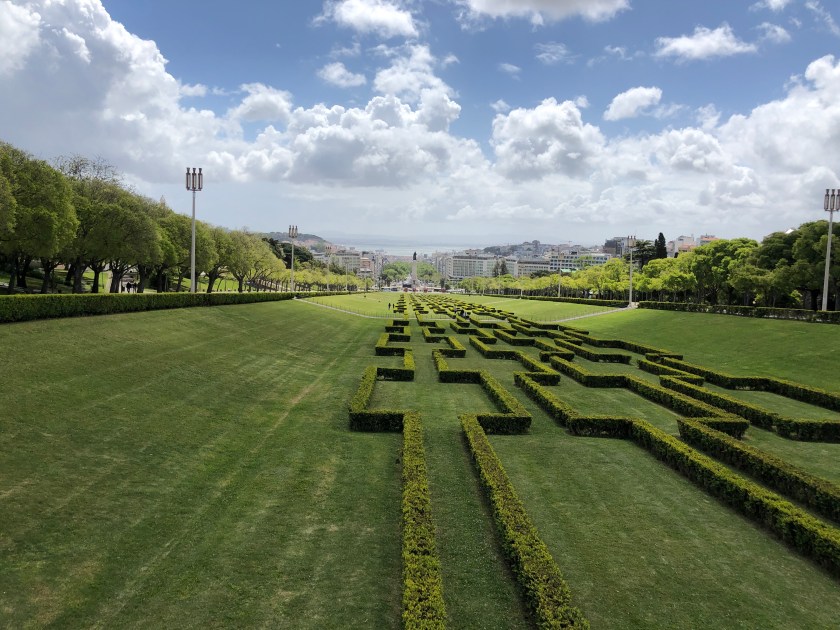
As we wandered down the length of the park we came across a gracious building hosting a Fish and Flavours exposition supported by some of the best chefs in Lisbon. Everything was a gourmet delight. Naturally we decided to participate and we had fabulous pulpo( squid) salad, scallops, cod and polenta, grouper, cured salmon with lemon sorbet, chickpea and bream stew followed by Chocolate Banana cake, Berry éclair and New York Cheesecake with macerated berry topping. All small portions of course but so delicious. We tasted great wines and olive oil. Everyone was having a great time and the presentation was wonderful. In the end we had a taste of modern Portuguese food and wine from the top restaurants for €20 each. 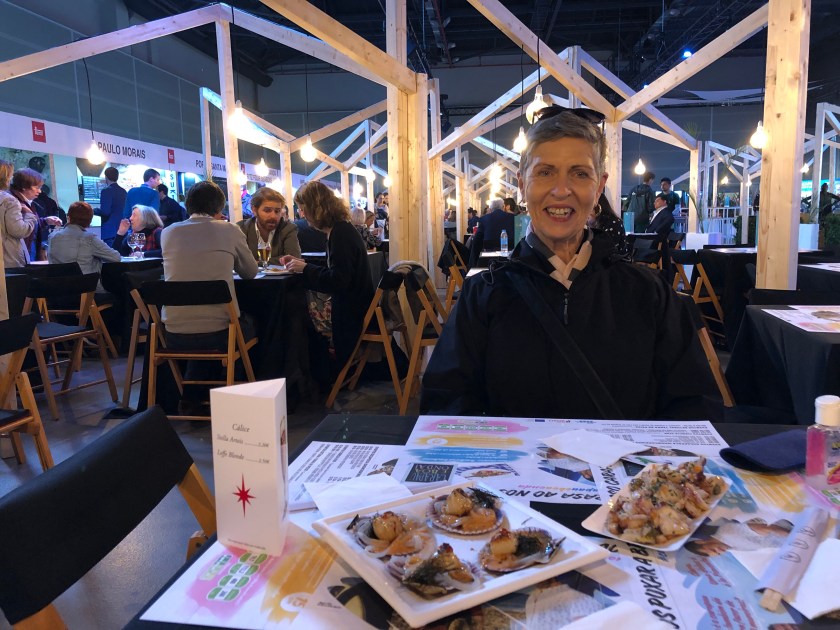
 It seemed great value. Unfortunately Irene put her new reading glasses down somewhere and they disappeared. She was really upset as she only got them yesterday to replace her broken pair.
The weather has turned really cold and we are all feeling a bit miserable and longing for warmth.
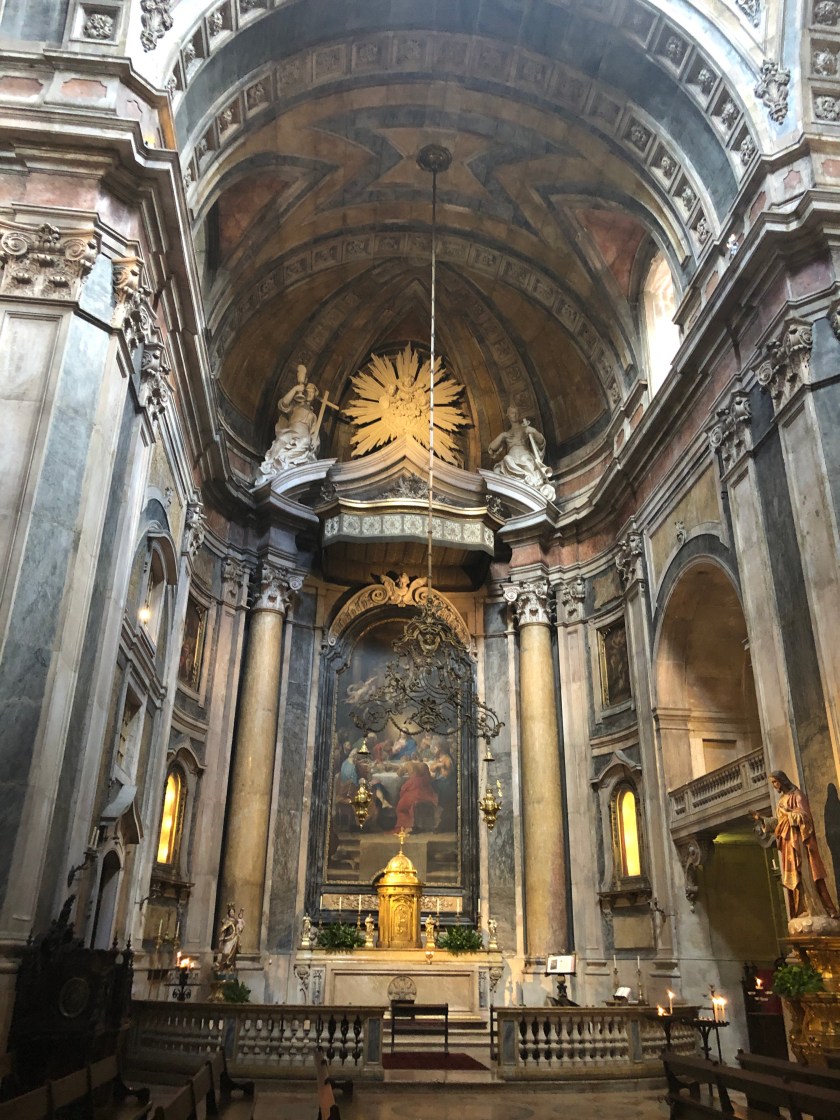
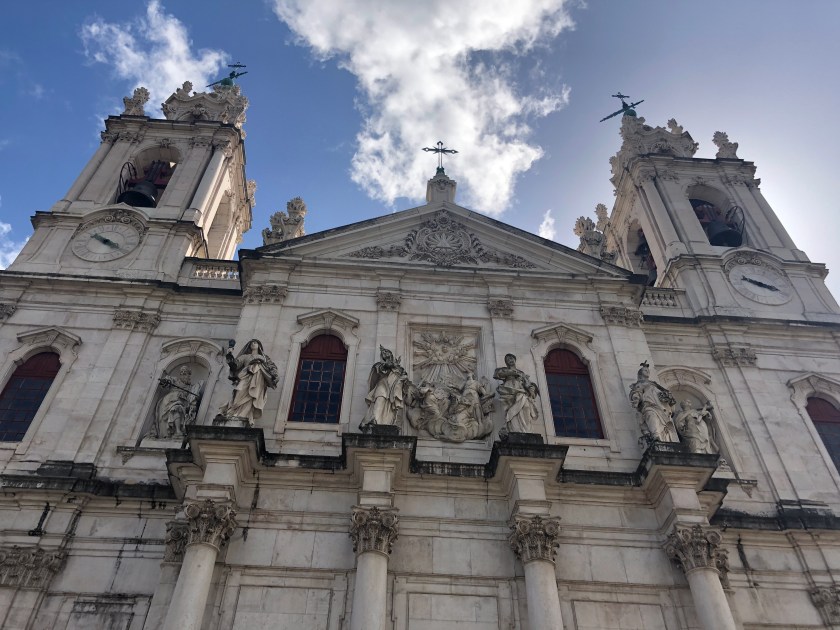
Our next stop was the Estrela Basilica a beautiful marble church with an incredibly detailed nativity tableau that took five years to make. It is based in cork and has ceramic and paper maché figures. To be honest I didn’t know whether it was good or ghastly. It is so detailed it reminded me of a similar type of creation in glass I saw in France last year. Unparalleled workmanship but beauty questionable.

Next stop the Marine museum again. We visited yesterday but the surrounding area has so much to see and we were too late and ignorant yesterday. We switched to another route and then felt it was ground hog day because we seemed to go up and back so many times on the bus. We started to crack jokes about all the buses we had been on, their different configurations etc. It had turned really cold so we were grateful for the shelter at least. We searched for the funicular but it was out of action for some unknown reason! Walking back up the stairs to our area warmed us up but not quite enough. We found a nice reasonable place to eat and warm up. We are enjoying the different food. At restaurants they often put out olives , bread, cheeses and salami, like an antipasto, and you pay for what you eat. No free bread or olives here. They leave it to tempt you while you wait for your main dish.
Arriving in Portugal 7 th April
Mary and Ross had warned us that there were long queues but we had no idea what an ordeal we would face. 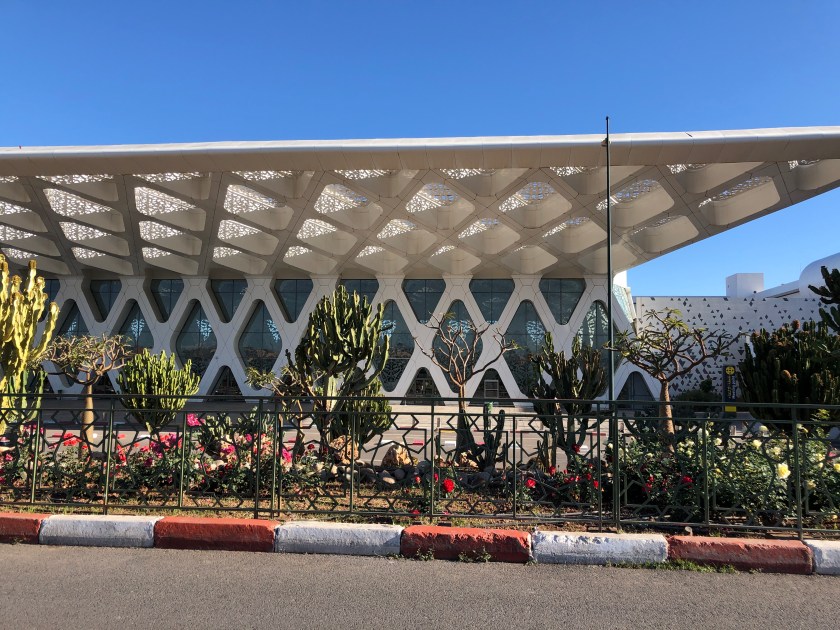 We queued to enter the airport. They just checked our luggage. We queued to check in and drop our luggage, we then queued to leave the country. Immigration was slow like a tortoise. People were close to missing planes because it took so long. Anne and I let a couple go through before us because there plane was taking off in 15 mins. In the end we also were rushing and once through we had a chance to go to the toilet and then we were boarding. I can’t see how duty free would do any business because no one had time to browse! Nearly three hours of standing waiting. Once on the plane it was a quick flight to Lisbon on TAP Air and despite leaving a little late we arrived close to our expected time. It was wet so we had a hard landing.
Going through immigration here and collecting luggage was a breeze and we were either in a lull or Sunday has fewer flights arriving. We were out and on our way to the taxis. Again Ross and Mary had told us to go up to arrivals to get a taxi because it was quicker which proved to be true. We stopped for money from a cash machine which kept rejecting my card. I wasn’t concerned because it had cancelled.
We found a taxi driver who happily gave us a potted commentary all the way to our apartment. Bill used his Spanish to converse and I used my few Euros to pay. 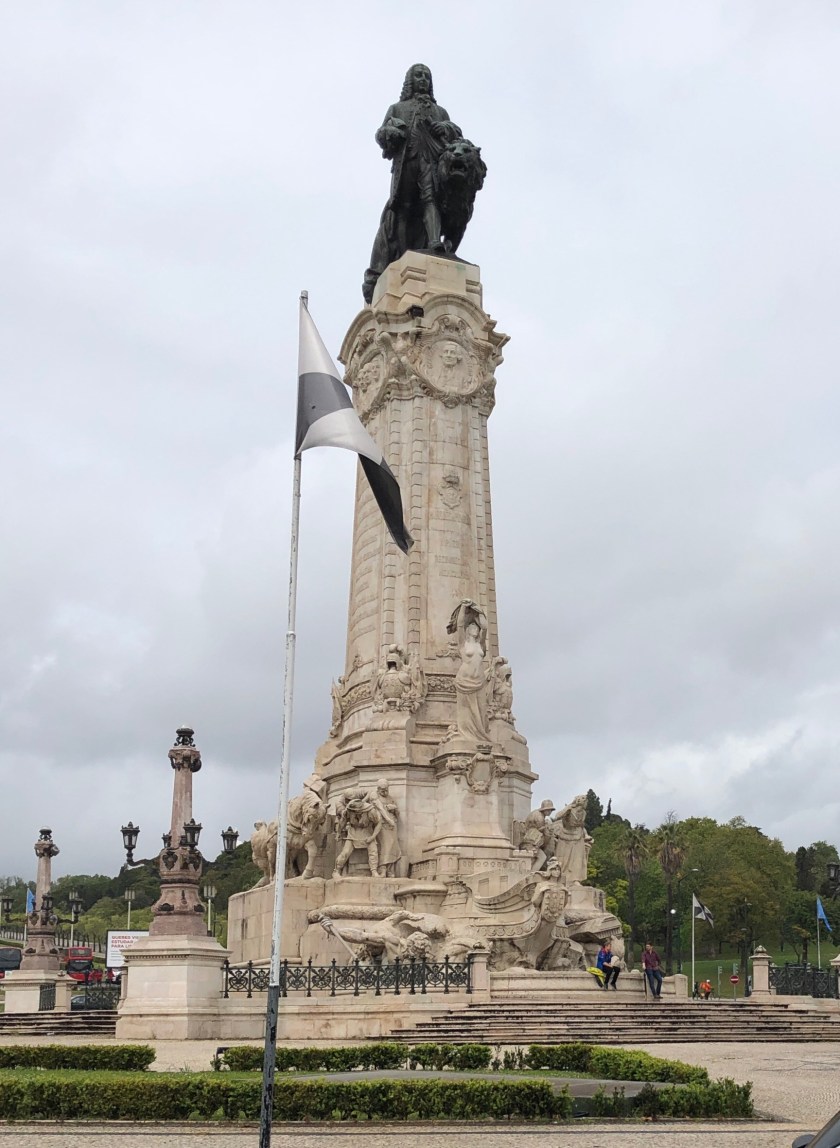 We trundled up to our apartment and then struggled to open the door. We stood around putting in the code until we managed to open it- almost by fluke. Inside we were met by a steep staircase to the second floor. My heart sank until I remembered I have a backpack on wheels. I promptly took out the shoulder straps and was able to get the bag upstairs without straining. I bought it for just this situation but have never had to use it.
We fussed around putting on some washing, getting excited about wifi that works and then headed off to a supermarket for provisions. We stopped at a hole in the wall restaurant for dinner. 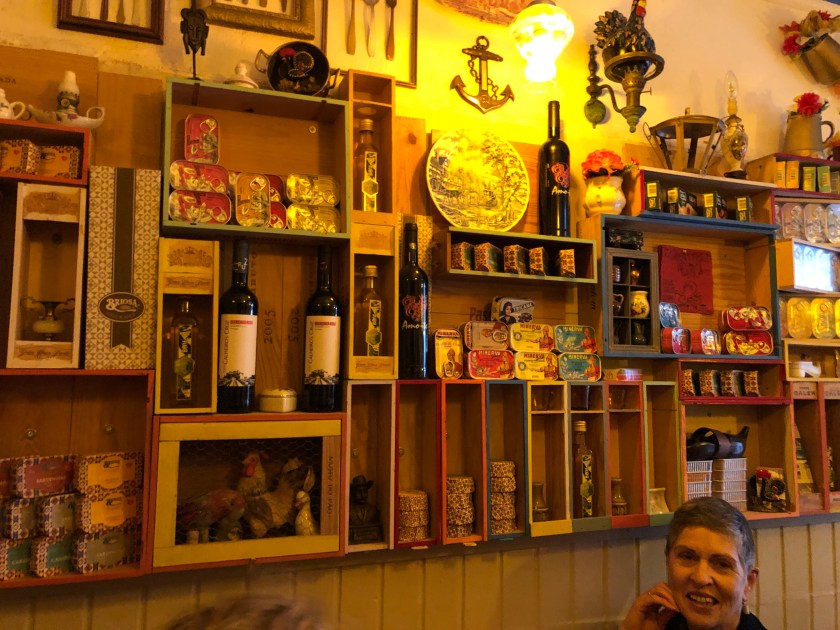
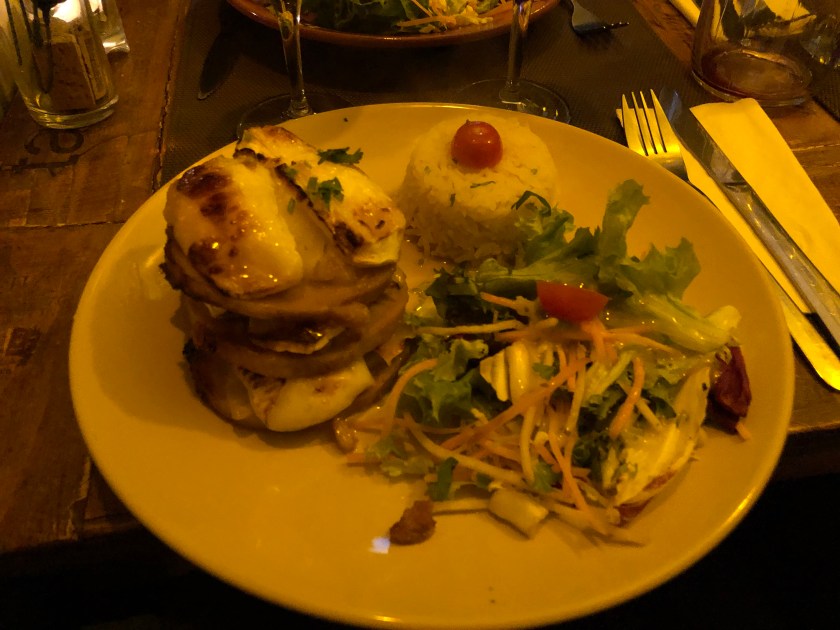 It was very charming and my PORK loin was delicious. Our waitress was very pretty and transgender and bought us a complimentary sherry after our meals. All was merry till we wanted to pay and I couldn’t find my purse. I felt absolutely distressed until Irene found it in the groceries! My heart was pounding. As it was I had managed to get some money out but the machine had said I didn’t have enough for the original amount I requested. I was concerned the cancelled withdrawals had taken the money. Later after accessing my account I checked all the withdrawals and realised I had not been keeping a close enough eye on the balance. All the tipping in Morocco and my few purchases had eaten into the balance! All was fine. Anne however is not able to manage her card because she can’t get the sms messages on her phone.

As the evening wore on our once quiet street was now a party! The taxi driver told us the revellers go on till three in the morning and he was not exaggerating! I was too tired to stay awake so no problem.
Last day in Marrakech
Today we were on our own, a bit intimidating after being looked after at every turn by our guide. The streets of Marrakech beckoned so we went off in search of the Museum of Photography, and the Saadian Tombs. The tombs we found because they were close by! They were quite magnificent and a lovely quiet place amidst the bustling streets. 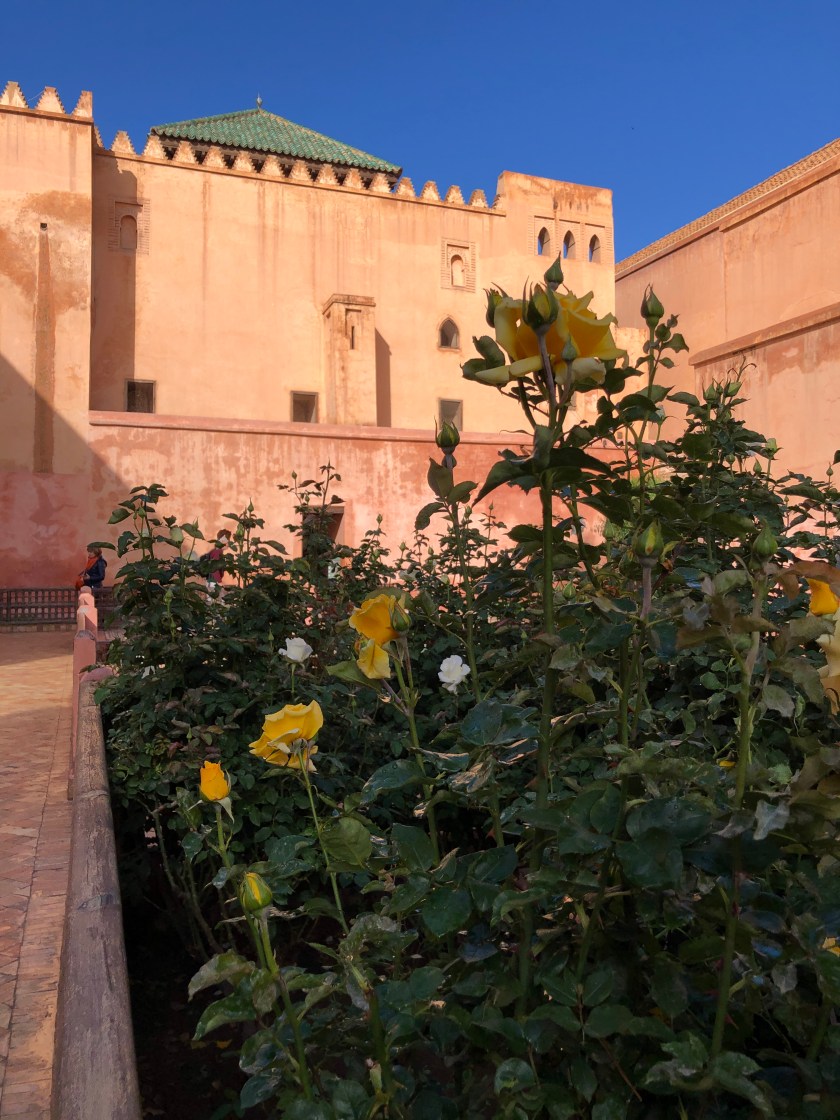
 The photography museum was more challenging. We became side tracked and each of us had different ideas of where to go. Bill was the only one with a working phone but even that was difficult. The street names were unintelligible or non existent but eventually we found our way around the souk and through some more upmarket shops to the museum. What an amazing place and fantastic photos. We discovered there was a terrace cafe from which we had a view over the city. In the lane a musician sang and played his oud(?) a type of guitar with three strings. He had a beautiful voice.We topped him as we passed.

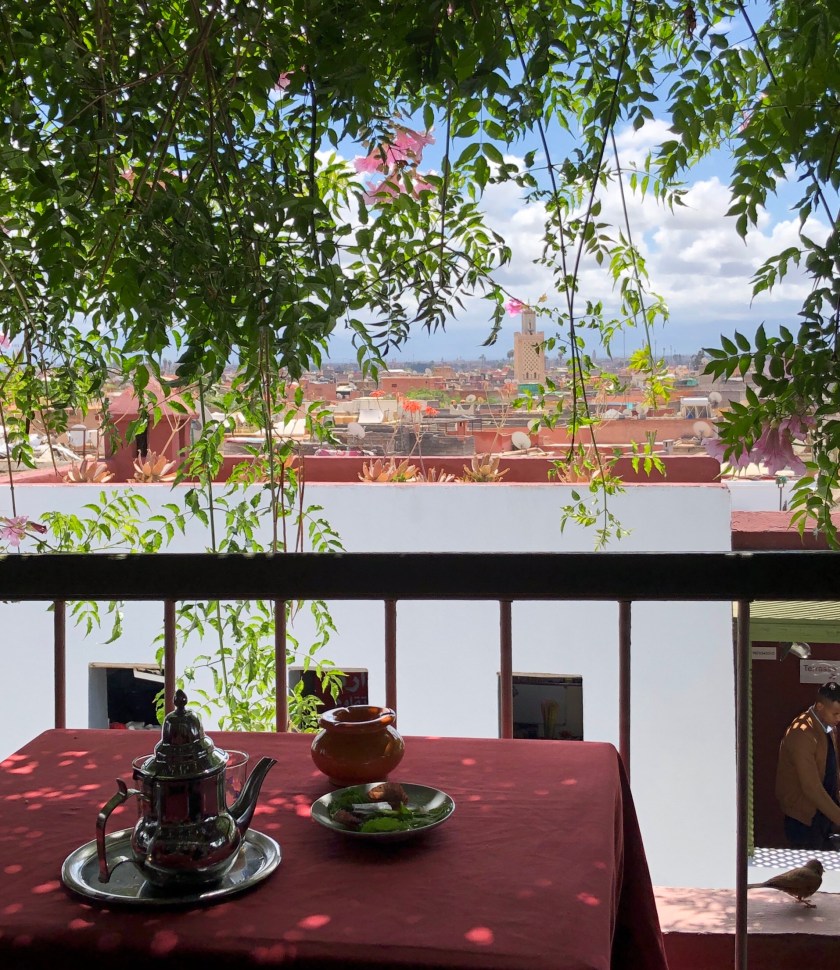
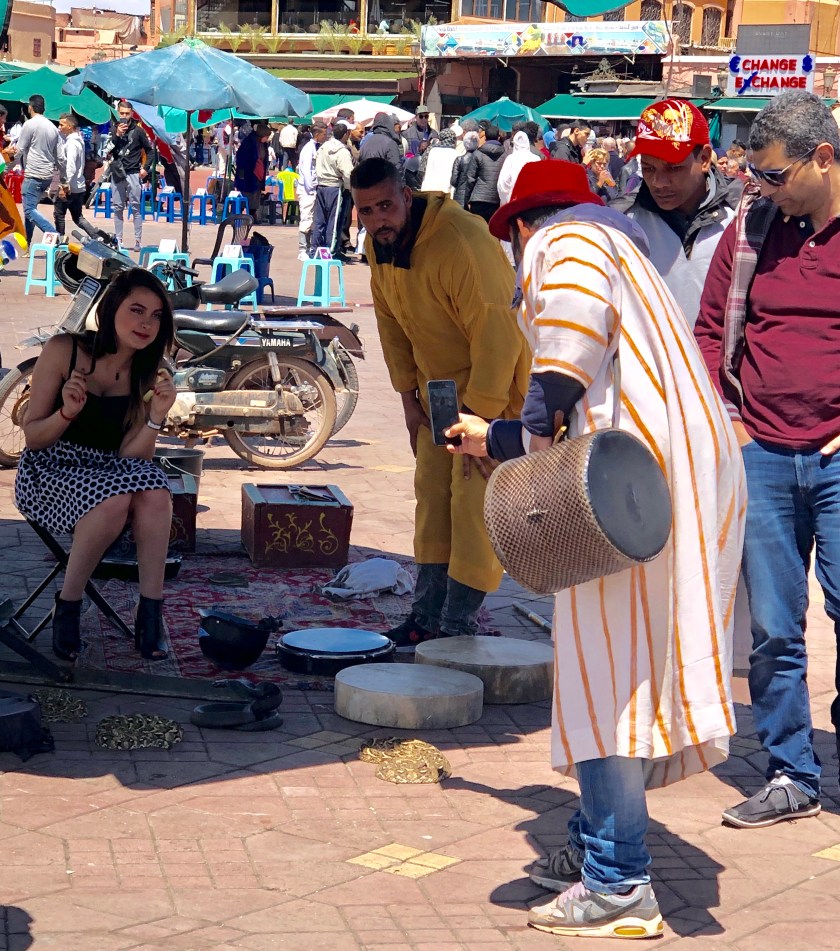
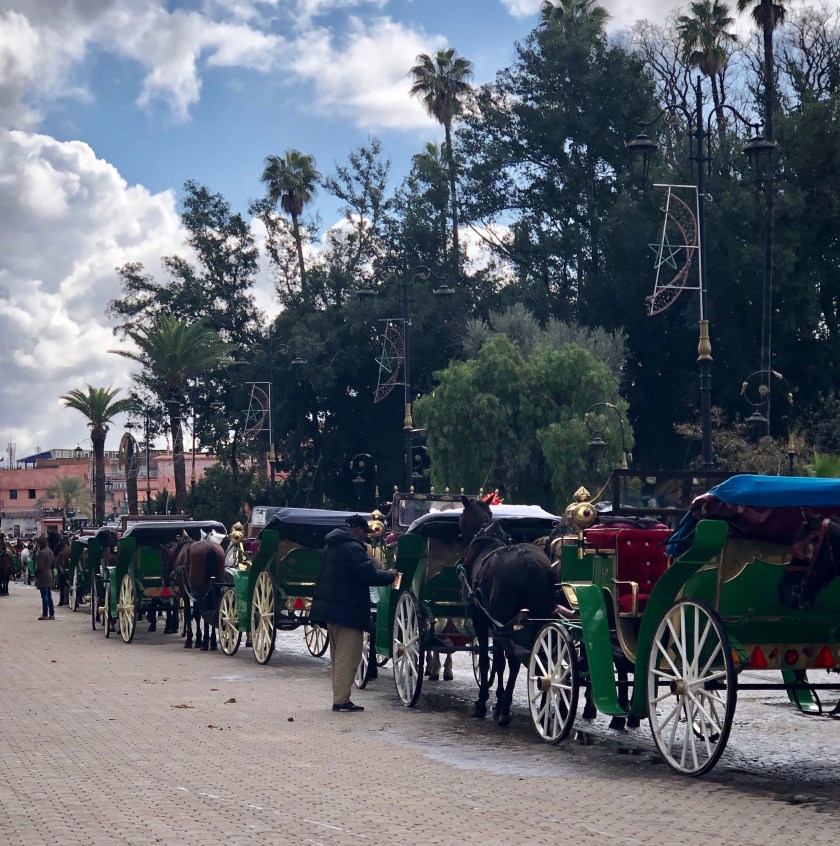
We then had to find our way back to the Riad to meet our driver who was taking us to the YSL museum. We were crossing the Jemaa el-Fnaa hoping to see some snakes for Irene. Bill was busy observing where we were heading when he glanced out of the corner of his eye. He was just about to stand on a Cobra! Boy did he jump. We all laughed when one of the snake men slapped his forehead while looking at Bill. In hysterics we bustled on, all trying to avoid being run down by horse and carriages and looking for the way back.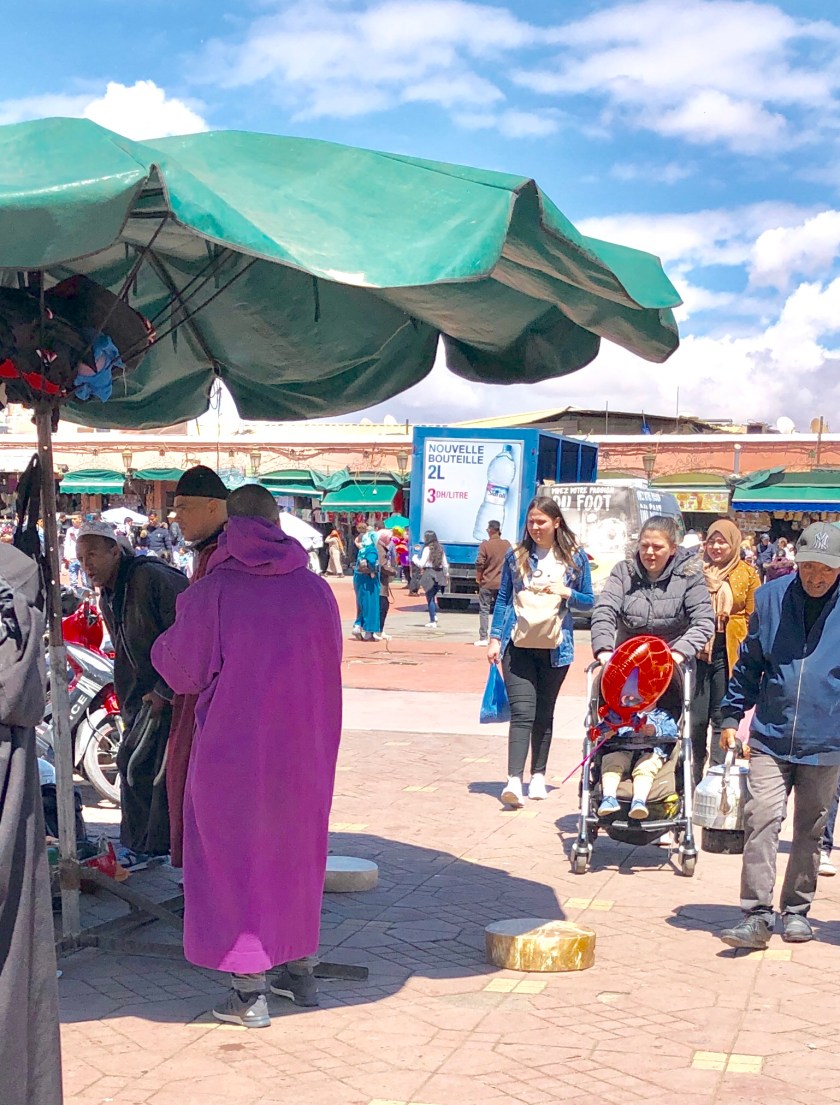
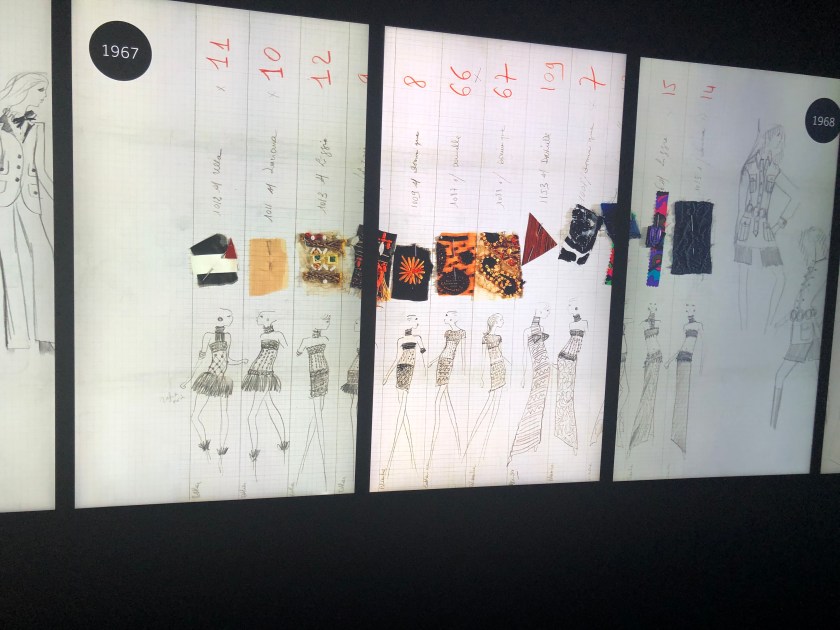
We arrived successfully and then set off again for the museum. The fashion held here represents the themes that influenced YSL. It was a sensuous, immersive audiovisual experience. 
 We returned to our Riad and said our final farewells to Ridouane and Rasheed. Those two men made our trip so memorable. Ridouane in particular was just wonderful. So vigilant and caring but lots of fun too.
He found a map of Morocco and marked our trip for us. It will be a wonderful momento.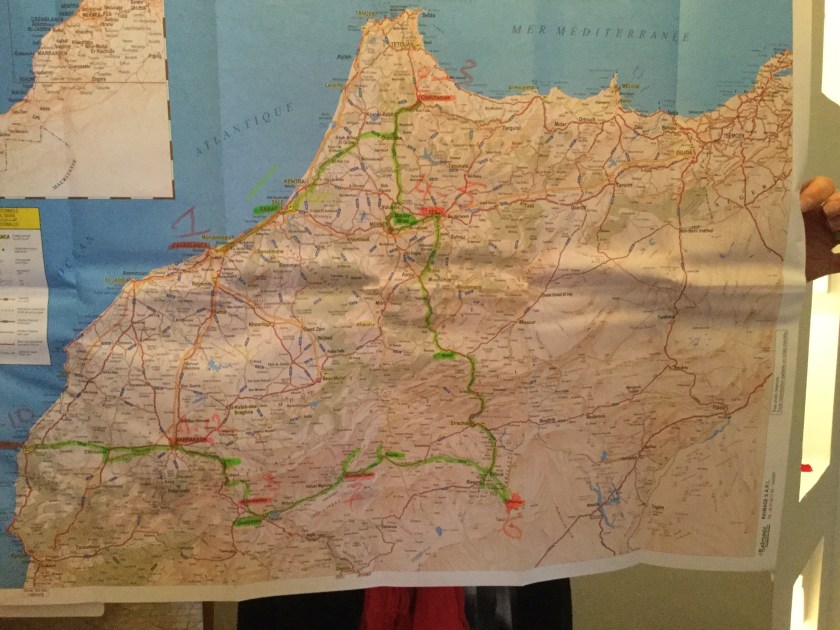
Essouria 4th April
Our hotel dining room is high above the city walls and from the terrace and windows we were able to see an expansive panorama of the sea and a beach. All night we had heard the sounds of the ocean, not realising we are quite literally at the waters edge. Essouria’s old Medina is built behind a port/fortification on a promontory surrounded by rocks and bordered on both sides with huge flat beaches. Unfortunately the sky was overcast so all was rather grey and dull.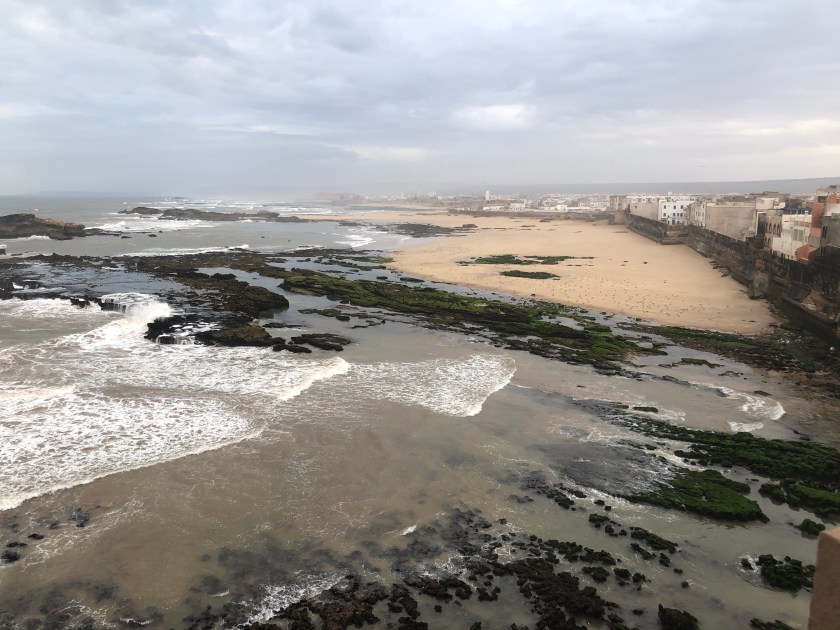
We all ventured out independently for a change. It was so relaxing to wander this Medina. There was a more relaxed ambiance and the lanes were a little wider. Anne and I found our way to the port where masses of seagulls wheeled overhead. I noticed there was not the same amount of squawking our Pacific gulls make. These birds were huge and probably well fed judging by the size of the squid one was eating!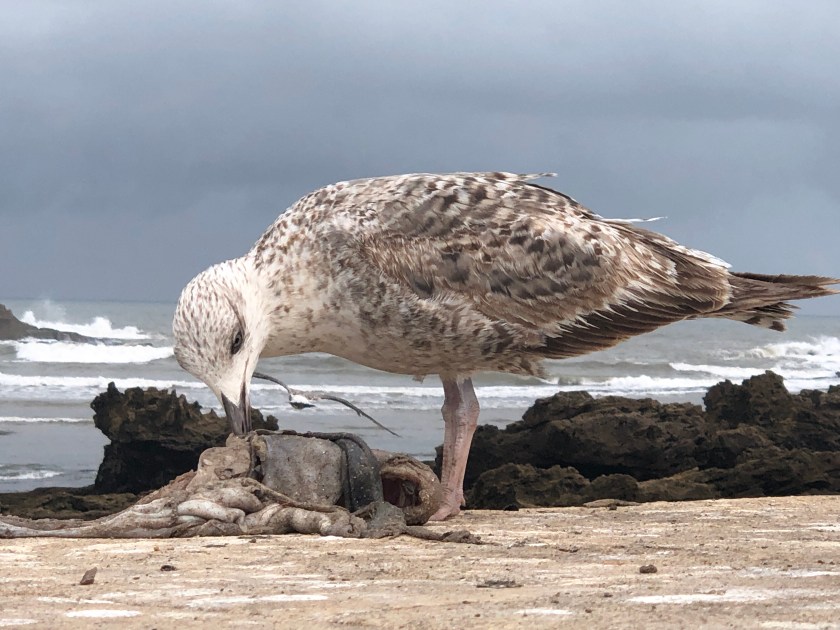
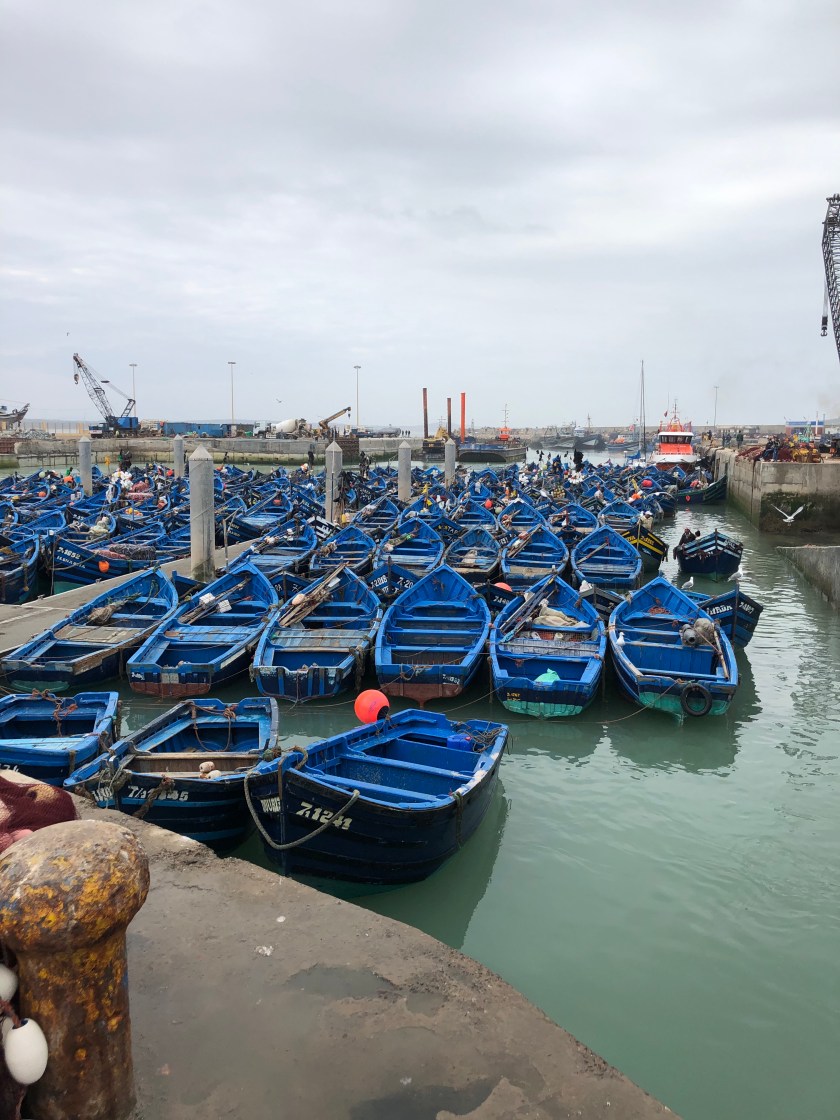
There were dozens of blue fishing boats tied together in little protected harbours or onshore receiving maintenance. We wondered how you would get out from the centre of the mass if that was your boat.
Anne and I continued down to the beach where kids were playing soccer and groups of women were strolling around with small children in tow.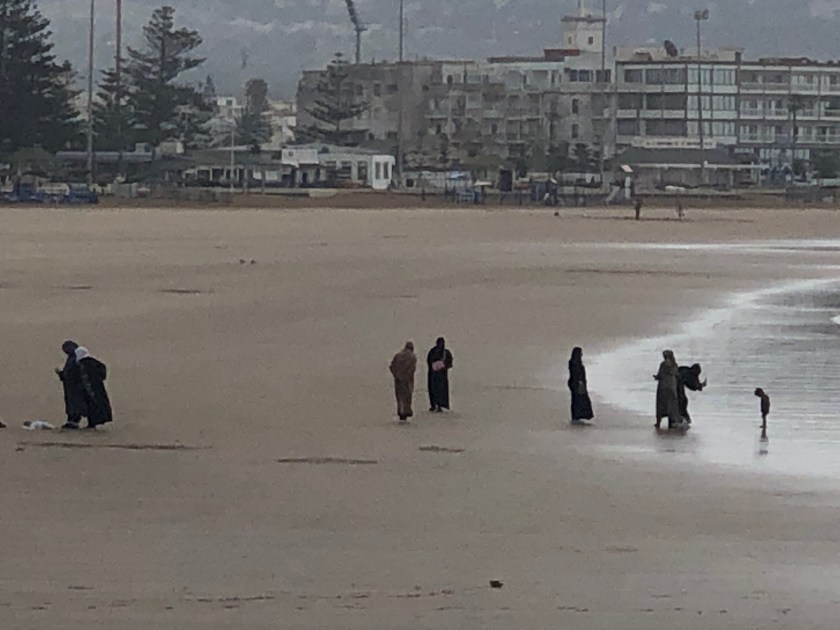
Returning to the Medina we found the shops and lanes were all bustling with people. Moroccan cafes are mostly for men, smoke filled and grubby, so sitting down for coffee is not quite as easy as we find in other countries. We found a place that was not trendy but there were a few other tourists so we didn’t feel too odd. The waiter was very pleasant and helpful, and though the toilet was clean the door didn’t lock and was minuscule. We stood guard for each other.
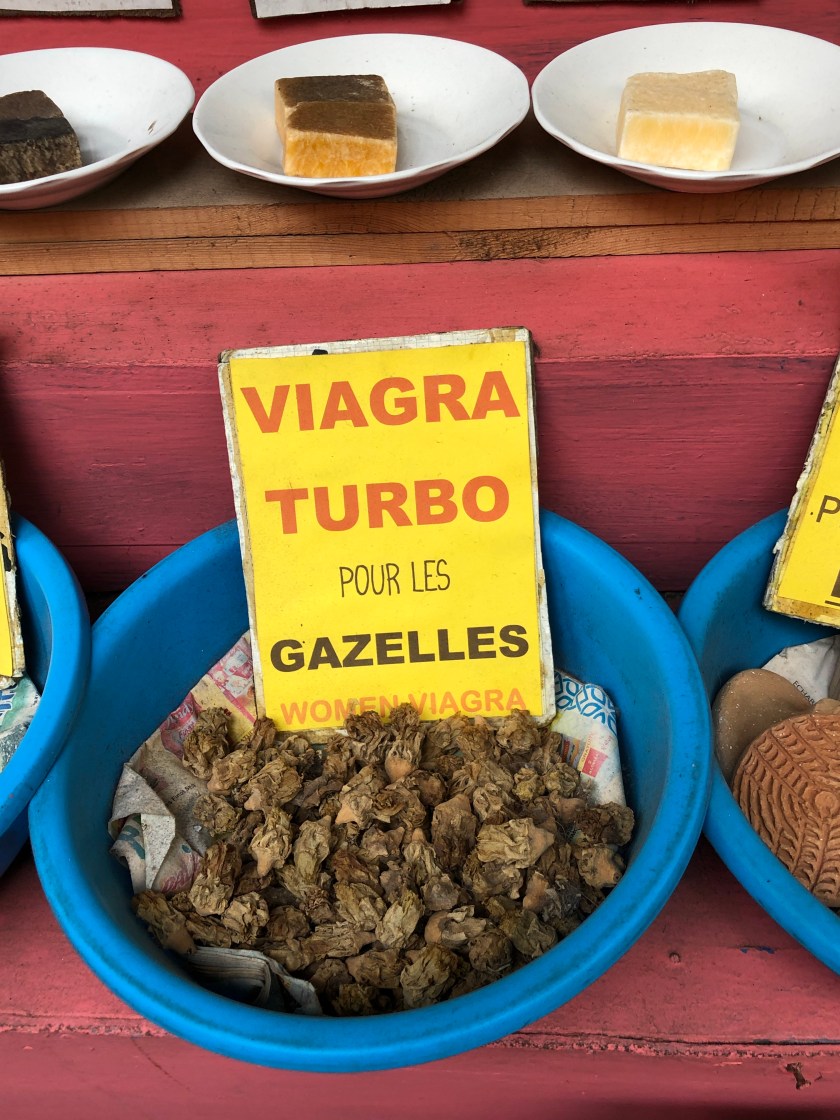
I loved the herbal/ pharmacy shops. They certainly had some interesting products. I love the fact that the Moroccans don’t care about juxtaposing different products. The butcher the fruiterer, and the dress shop.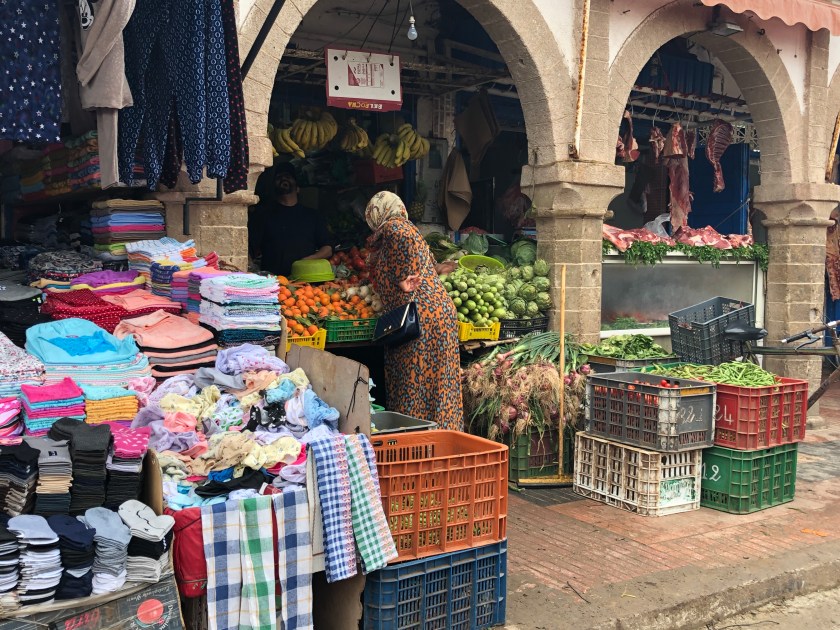


Ridouane met us for lunch and we had fish tagine in a very authentic restaurant but decided to go to the Mega loft for dinner. This was a very trendy place serving modern Moroccan food. We recommended it to Ridouane for further groups. He was conscious that we had been eating traditional Moroccan food for two weeks and we had a running joke about Chickens. This is a common ingredient for tagines and Ridouane’s favourite. Ross said that if a chicken stopped laying eggs you put a lemon beside it and it knew that it was for the pot if it didn’t start laying again!
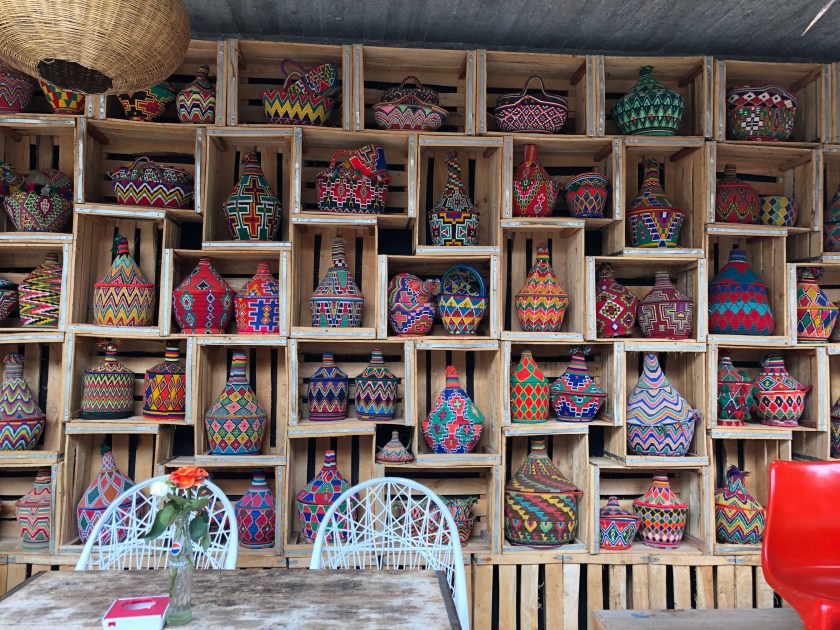
This quirky place really appealed and the food lived up to our expectations. Anne and I came across a holy man and his entourage. One of them had a pole onto which people were tying scarves and socks for healing. There was such a press even the locals were taking photos. There was a procession of musicians as well making a great clamour. It was quite exciting, though I did think it was an ideal time for pick pockets! No such calamity occurred.
Our final experience was the Hammam. Wow. Bill and Irene had a couples experience. Anne, Mary and I undressed to our skin and and were taken into a hot tiled room where we were sluiced with hot water, soaped then sluiced again. Next we were rubbed over with argon oil and told to turn over. I felt like a suckling pig in danger of falling of the spit! We were exfoliated vigorously, sluiced again, oiled again, then rubbed with sand and left to broil for ten minutes, then sluiced again. By now we were very warm, hearts pounding and with a final sluice we then went for a massage. Heaven is a Hammam. Mary promptly checked google for one in Melbourne. The price at home was about $300. Here we paid $75! But we do have them!
We were all very relaxed to say the least and Anne found subsequently that the argon oil did make her hair very soft, just like the sales lady told her!
Next stop Marrakech our last town.
On the road to Essouria
This was a long drive today over the Tishka (or Difficult Pass) to Essouria.
This was the only way the caravans could cross from the plains and desert over the mountains. It was an arduous journey and in winter it was snow bound. Today they are widening the road so our journey was beset with road works. It was another winding road so I sat in the seat in the middle behind the driver to avoid feeling car sick. Rasheed our driver is fantastic. Very safe and a smooth driver. We have all felt very comfortable with him at the wheel. Leaving the valley on the east of the mountains.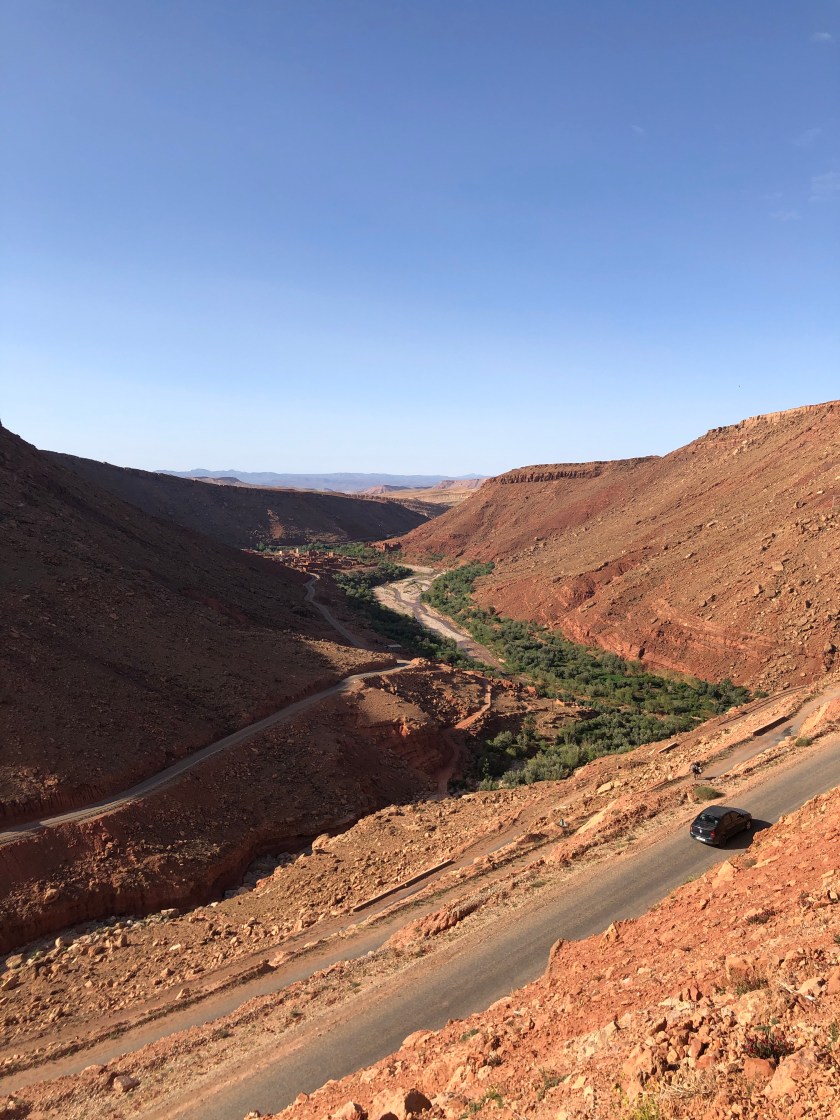
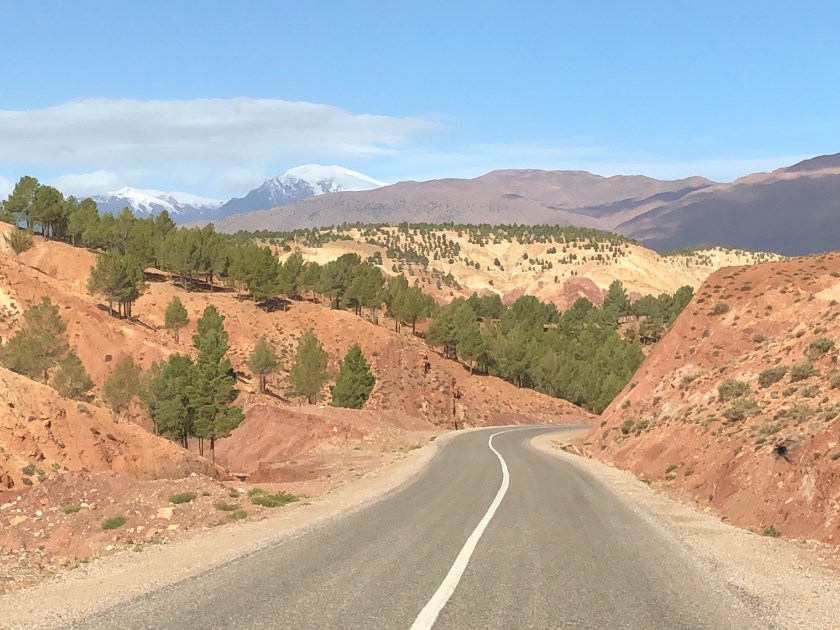
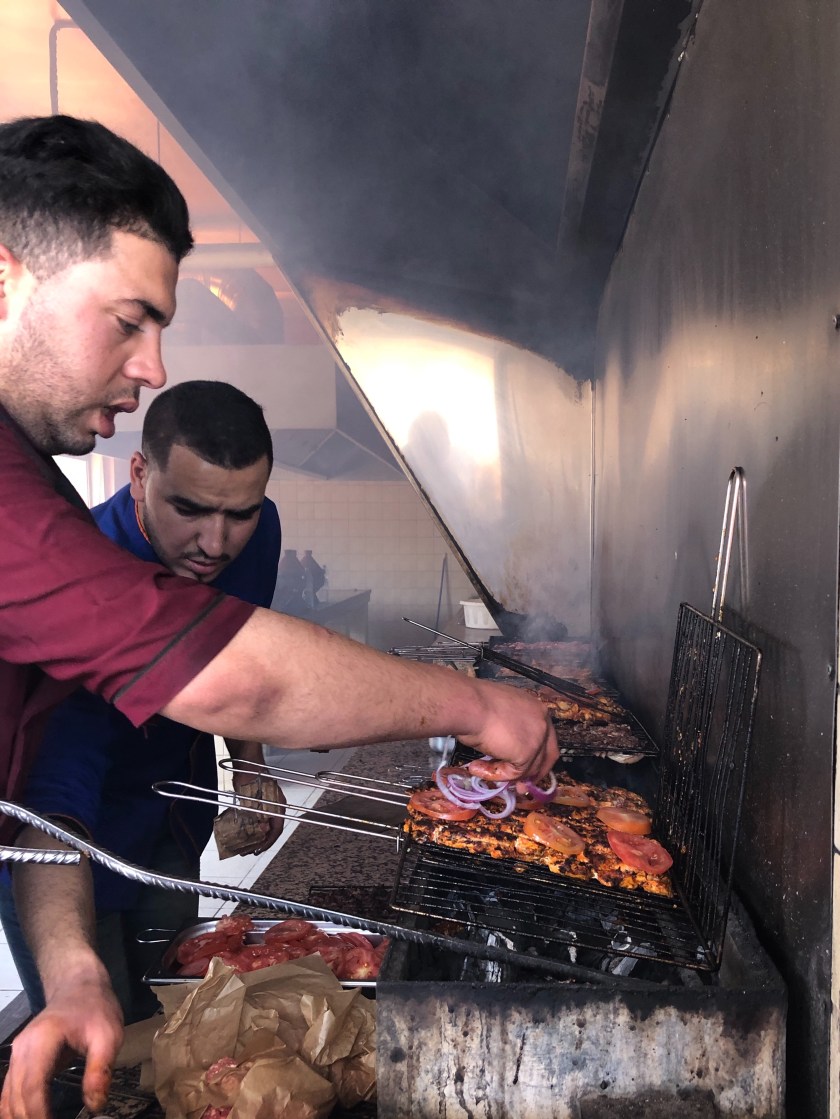
Thé terrain changed from desert to quite lush green once over the pass. We stopped for a grilled bbq which was to be a special treat. The butcher minced the meat right in front of us and then we went next door to get it cooked. We took some photos but one of the men wanted Ridouane to order extra salads and food because we are tourists. He wanted us to have an authentic Moroccan experience and was offended by this fellows attitude. Ridouane was very angry with him and reported him to the manager. He was very upset with this man’s behaviour. Ridouane is always courteous and never tries to take advantage of us or let anyone else do that either. The meat we had was very tasty and different from our other meals.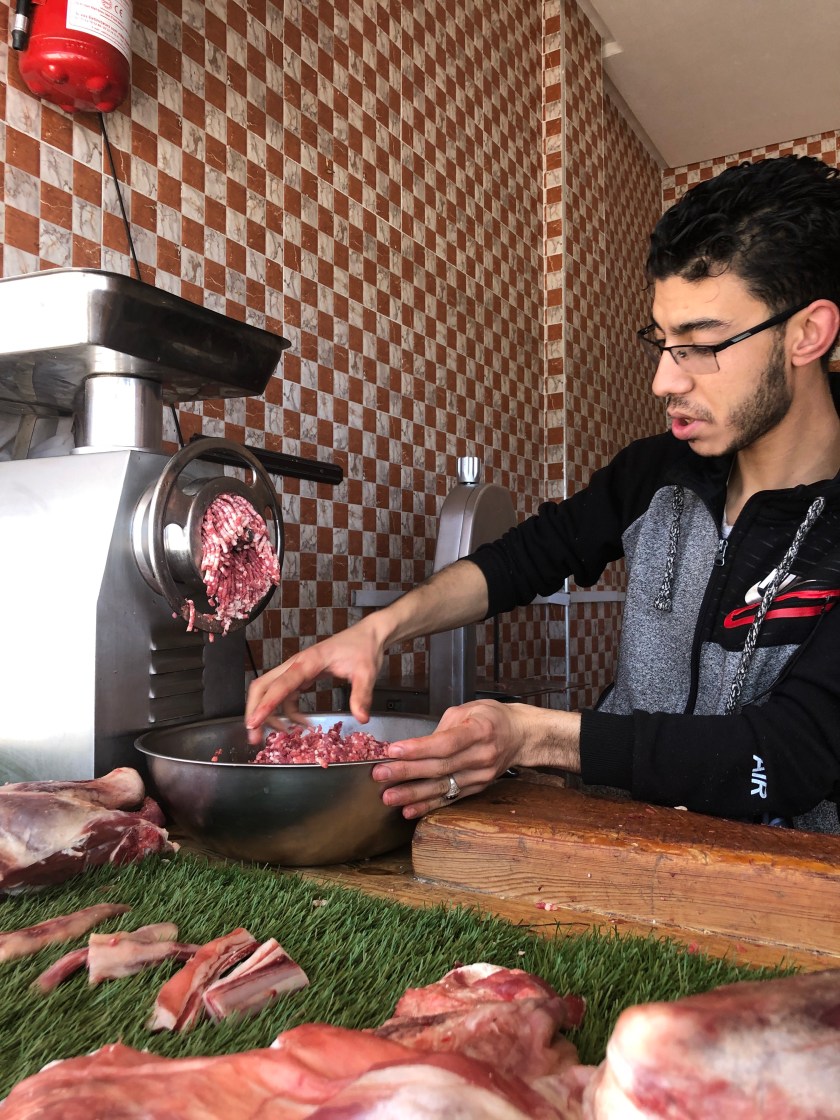

after lunch we hit the road again, encountering almost endless roadworks. We were fascinated by the children sitting watching the big machinery. No health and safety here!
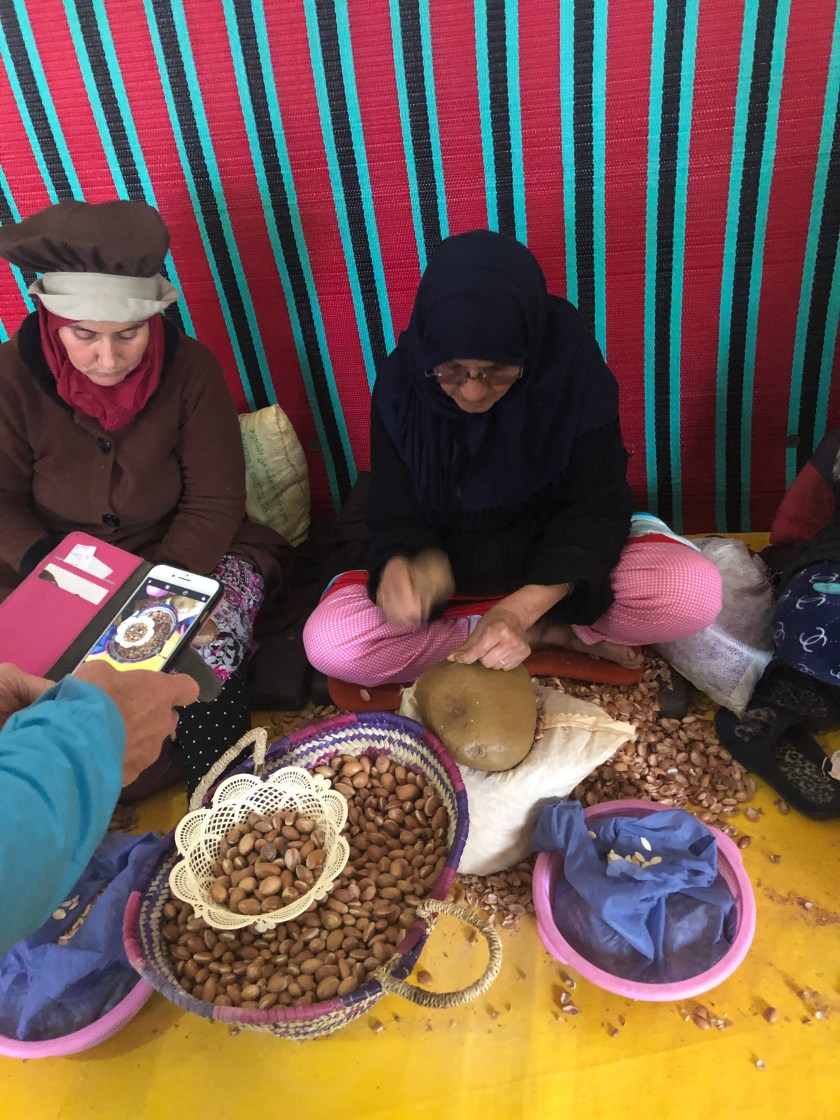
The road was another winding descent until we got to the bottom and it became desert or arid again. Our next stop was a brief bank visit in Marrakech before the argon oil cooperative which we arrived at quite late. The woman guide was very pleasant but spoke so fast and wasn’t really good at listening to our questions. After the brief tour we ended up in the shop where this super saleswoman told Anne she needed Argon oil for her hair! They also sell a miracle serum from Cactus flowers which we all needed according to her! Curiosity got the better of us and we bought the products and had them all shipped to Anne’s Mum in Australia. We are going to be looking amazing by Christmas.
Argon oil is quite rare and exclusive to Morocco. The tree bears nuts shaped like olives which are shelled and ground into a paste and then distilled. We tried this super delicious Nutella like paste made with almonds honey and argon oil. That was a definite winner.
From here we finally arrived in Essouria on the coast. What a shock. Desert, snow capped mountains, gorges, lush valleys and the sea all in one day. It was grey and cool when we arrived.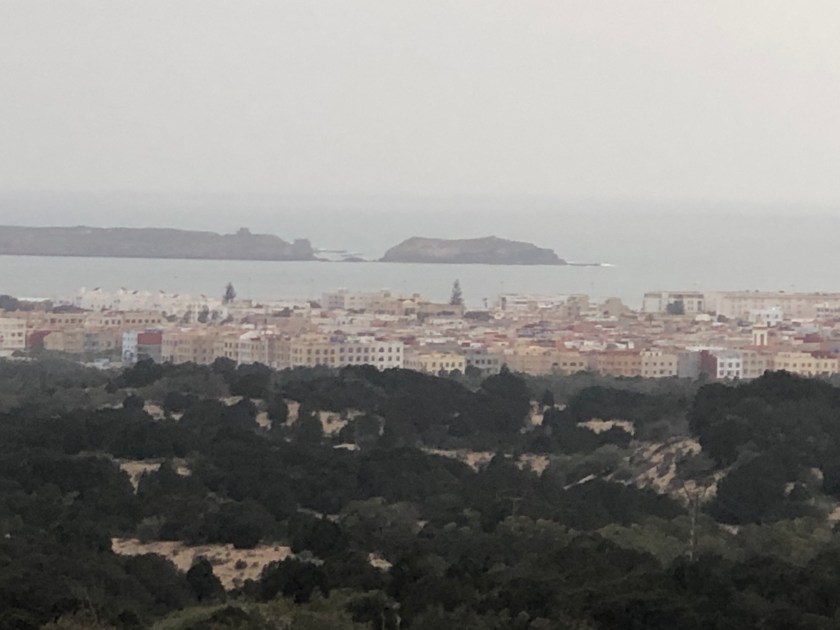
When we arrived at our hotel in the Medina Anne and I had a double bed and a trundle. I was not very happy and requested a new room. We were refused politely and we were too tired to argue. The room is lovely otherwise, though we can’t get the Internet in the room. We can cope.
Ouarzazate 2nd April
We started with a drive up the Toudra gorge. This is spectacularly rugged and often used by mountain climbers. We saw two in the process of going up. They were just specs on the rock face.
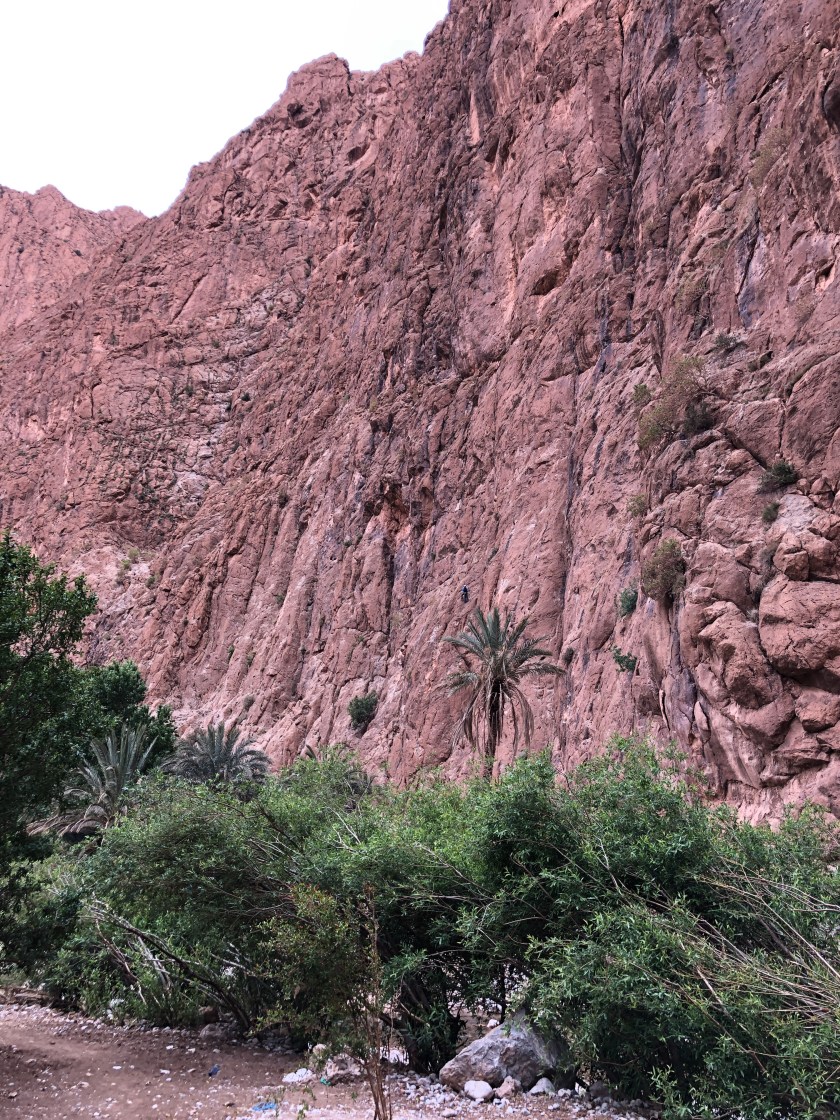 It was hard to see the second climber! The gorge was so impressive.
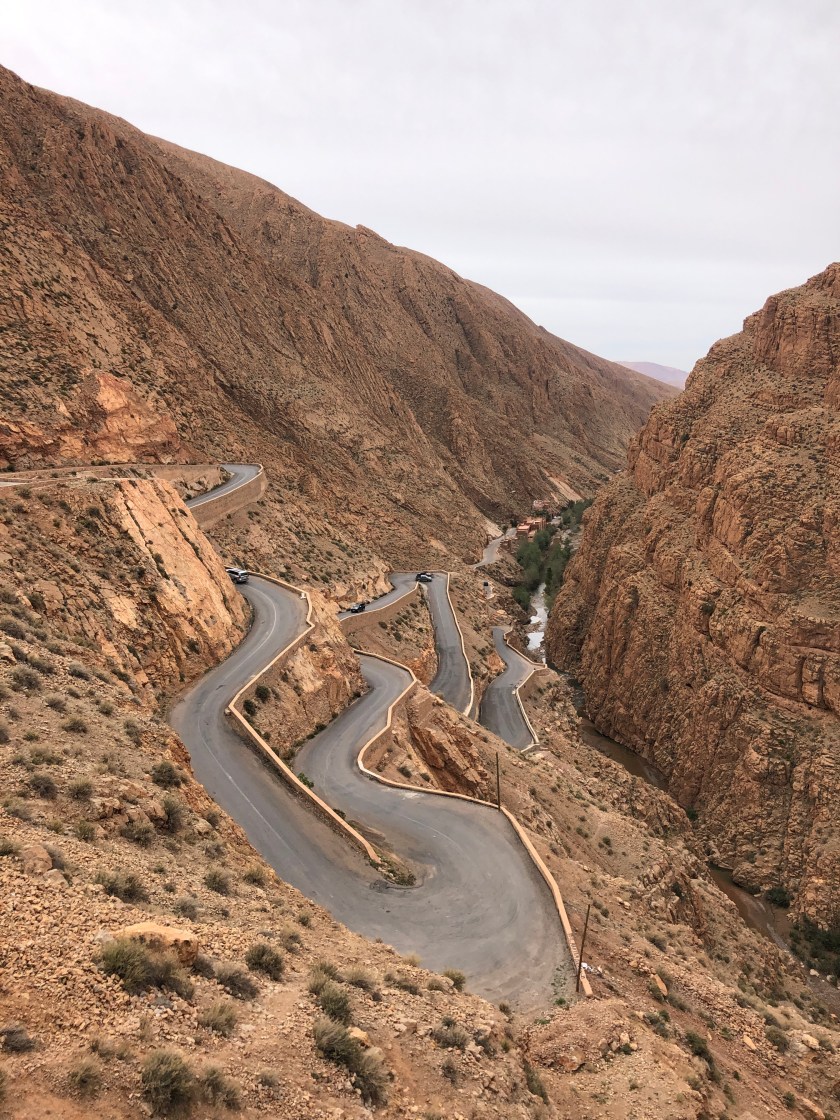
 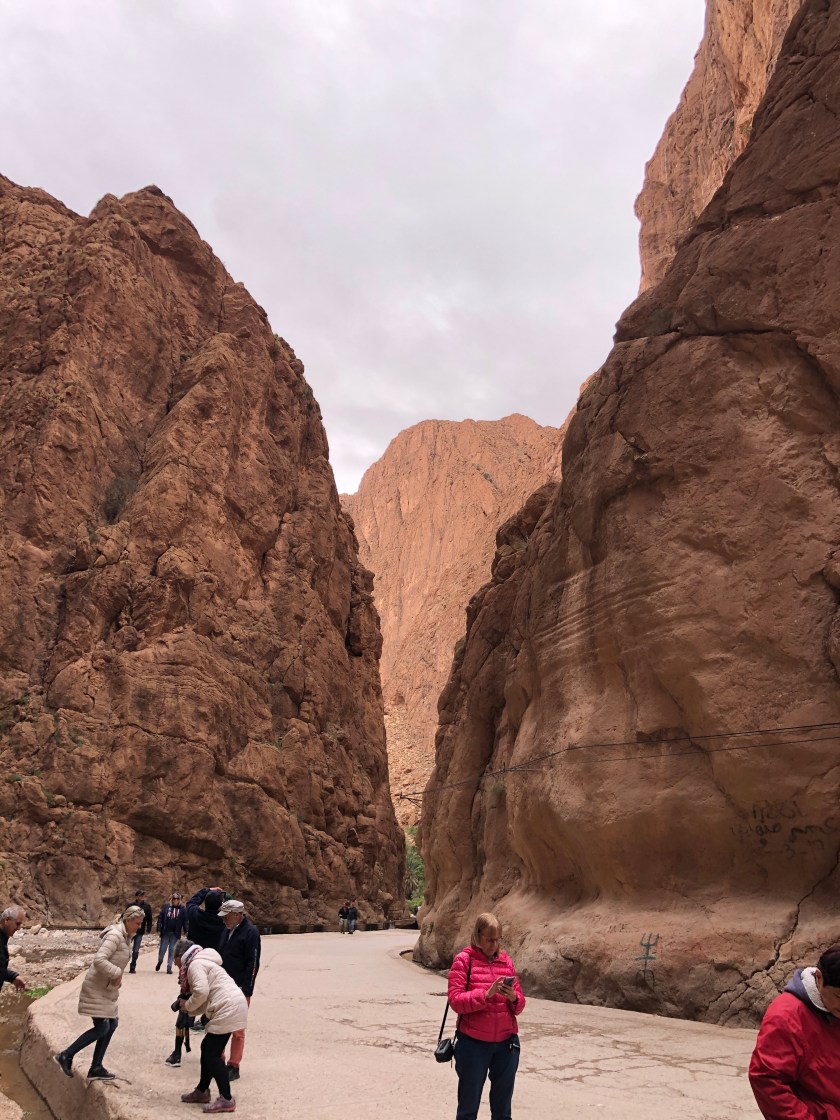 Then we drove up to a wonderful vantage point to see the road called the intestines because of its steep bends. Mary pulled the curtains across so she couldn’t see the sheer drop to the valley. We had passed other strange rock formations that were like monkey’s fingers.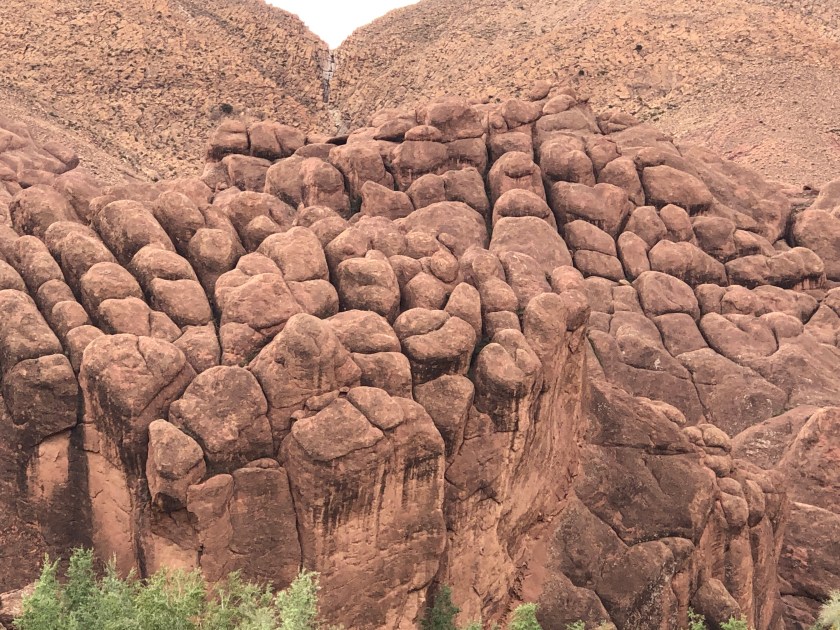
On we went then driving across a desert plateau with the snow covered Atlas Mountains on the horizon. We passed through many dusty little towns, past salt plains and the largest solar farm in the world.

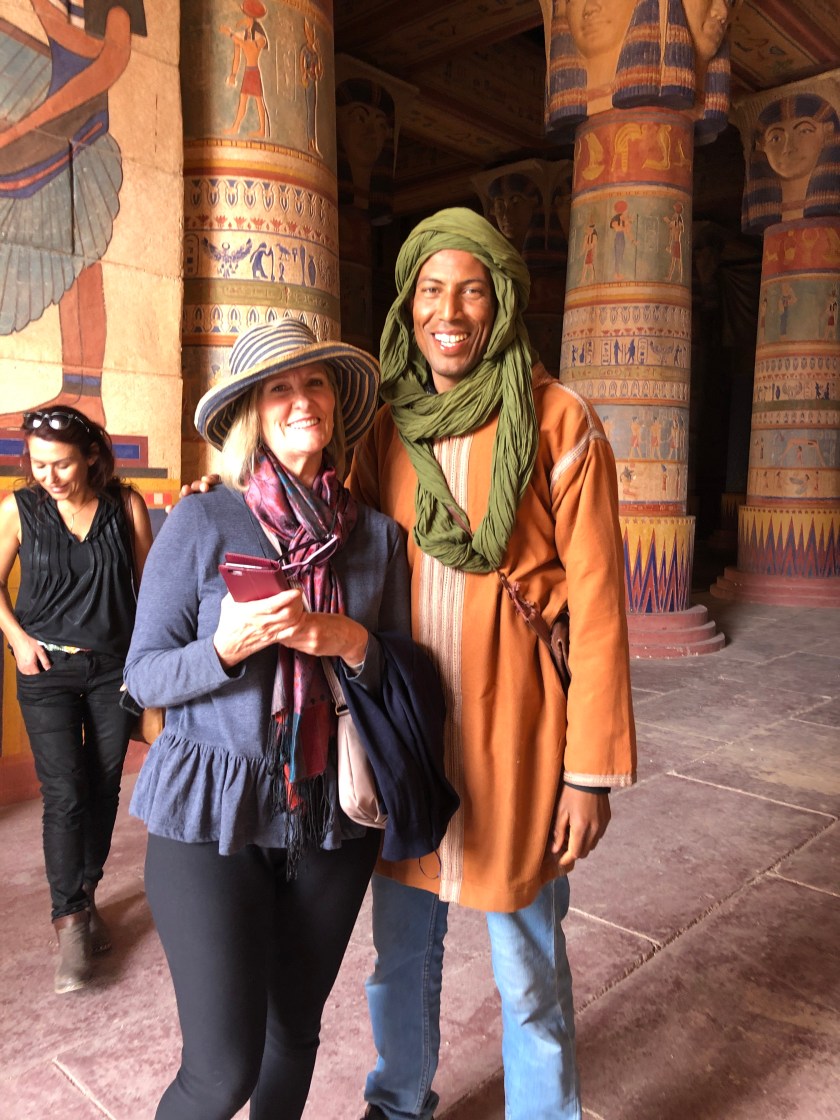
We stopped for lunch in Ouarzazate before we visited the Atlas Movie studio. Many famous movies were shot here, like Gladiator with Russel Crowe, Babel, Black Hawke Down, and more recently Game of Thrones. It was a fun visit and our guide was so handsome we women were all impressed. He had been one of the extras in Game of Thrones, Season three, episode five. He is actually a film maker himself but he told me he only made small indie films with his friends.This is the cage in Gladiator and our gorgeous guide.
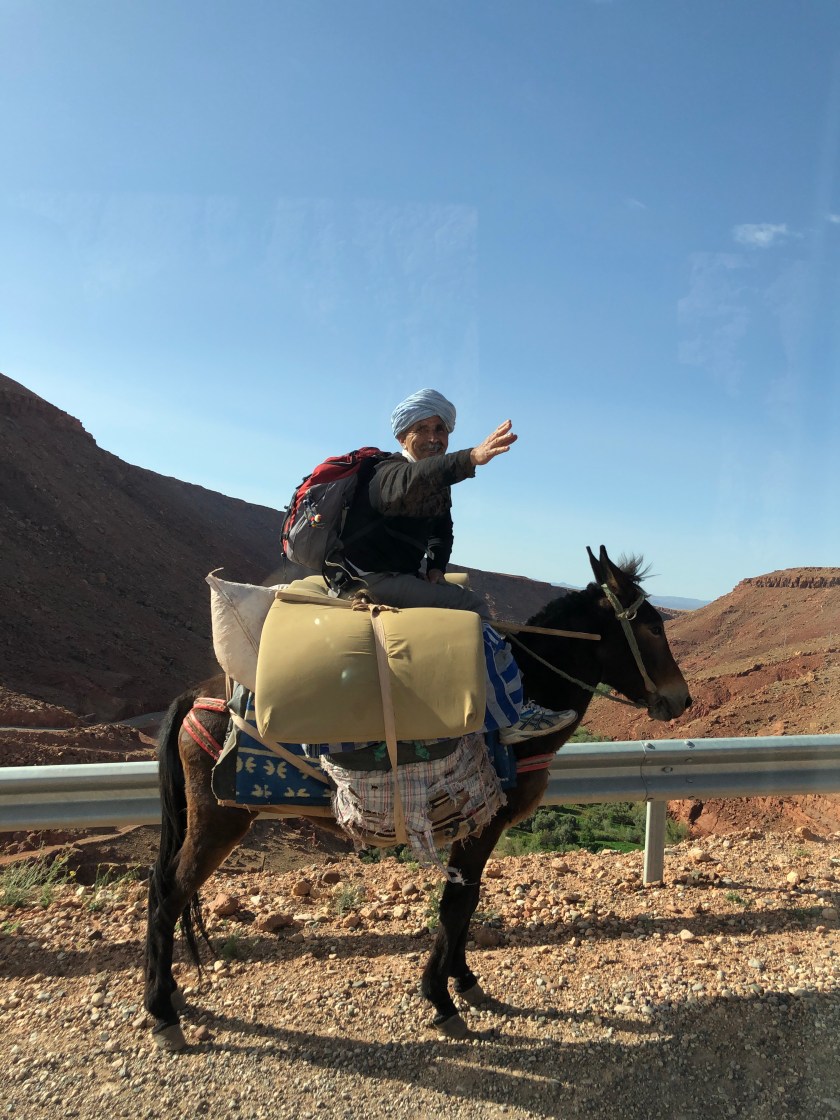
Along the roadside we often see women carrying bags of herbs or grass for their animals  . Irene became fixated with trying to get a donkey and driver shot so we all were on donkey alert but she couldn’t get the camera to work fast enough and got legs, heads and tales. I was luckier. The humble donkey and mules are everywhere pulling carts or carrying produce and owners. They are essential in this country.
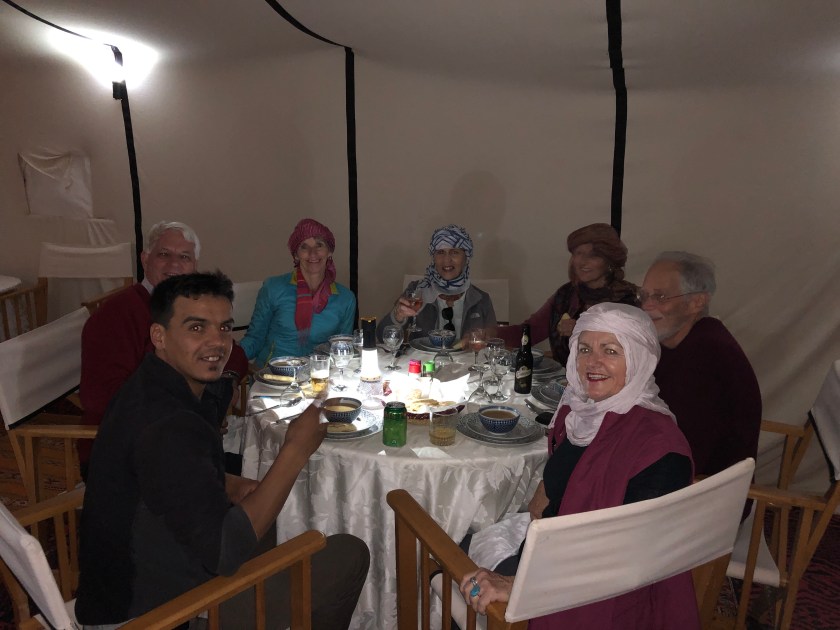
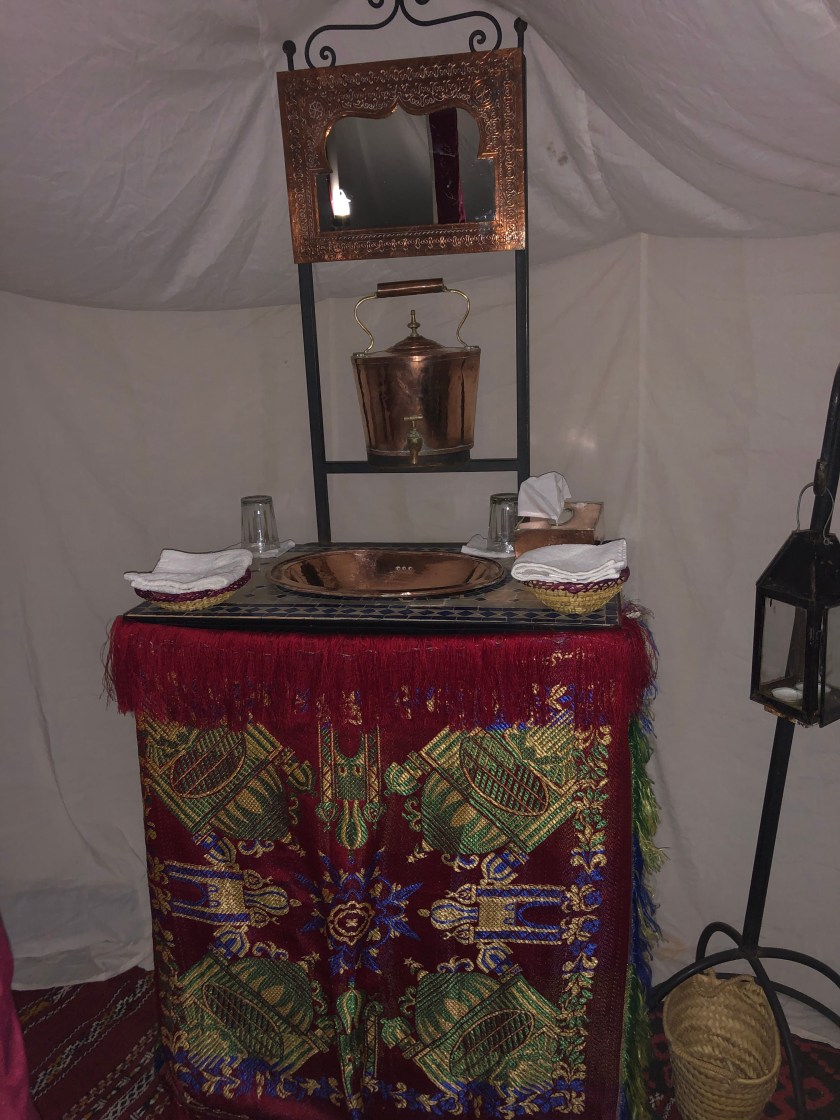
Dinner in the desert camp


Desert camp 1st April
We drove from Fes to the Sahara. We passed forests with Macaque monkeys and climbed into the mountains. The scenery was spectacular. Along the way we saw patches of snow here and there and the temperature started to fall.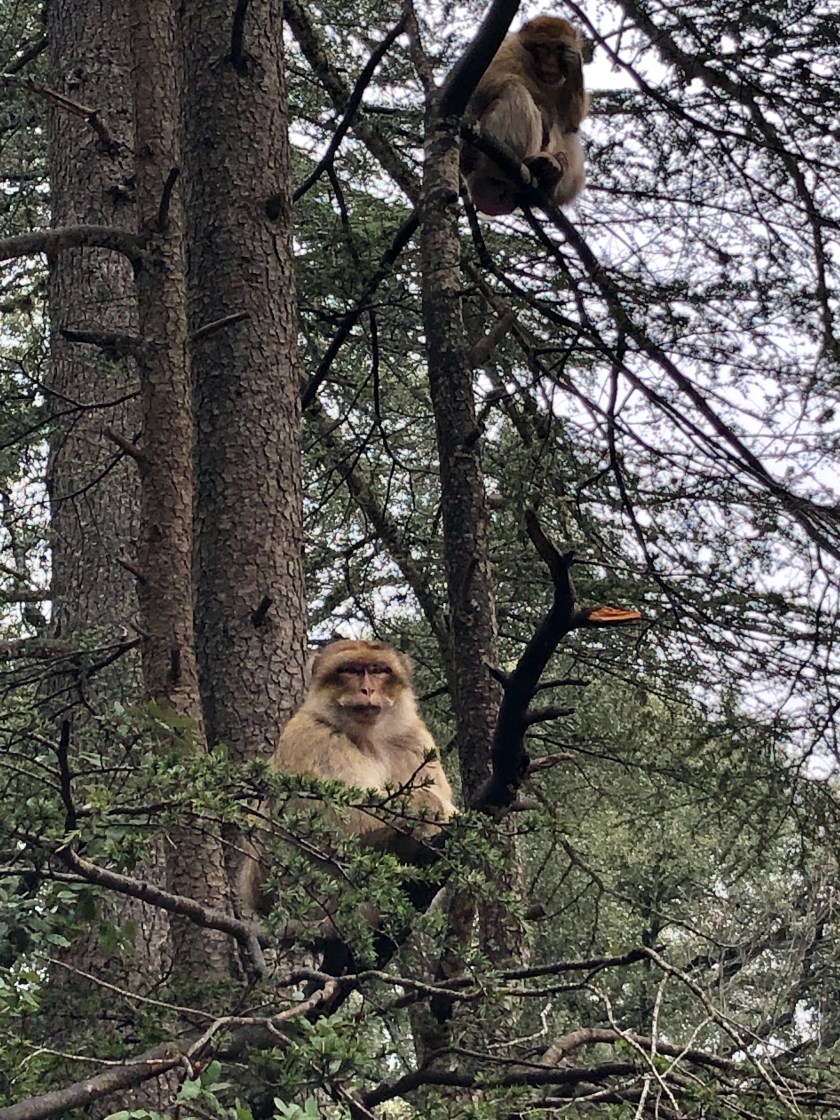
These are the type of villages we passed. They are in oases in the valleys where there are streams. The landscape is so rugged and harsh, not unlike Australia or the Nevada desserts.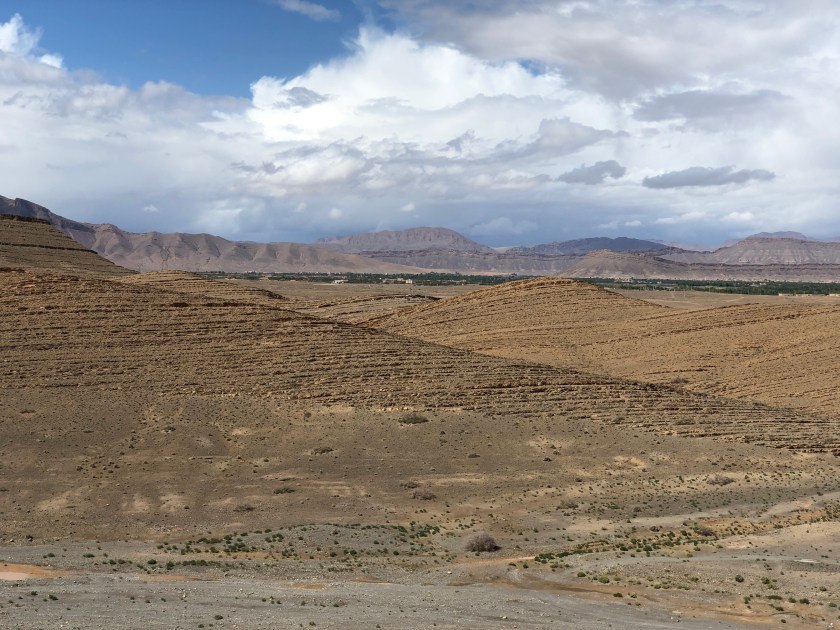
On the way we stopped at a fairly unremarkable restaurant. We had seen people fishing in the river and Ridouane had said they were fishing for trout. I thought he was joking and said I hope we get some for lunch. We were delighted when that was what we received. It was such a nice change from Tagines. I actually ate two because Mary doesn’t like fish with the head on. It was so fresh.
What surprises us is the barren country suddenly reveals a green oasis of palms or green trees and farm plots. These valleys are long and often surrounded by steep rocky cliffs on which villages have been built. Most of them have been settled since the 16 th century or earlier in the 11 th century. The architecture is the same now as then only they use concrete instead of mud bricks. The towns mostly look dusty and shabby but inside the homes are quite lovely. 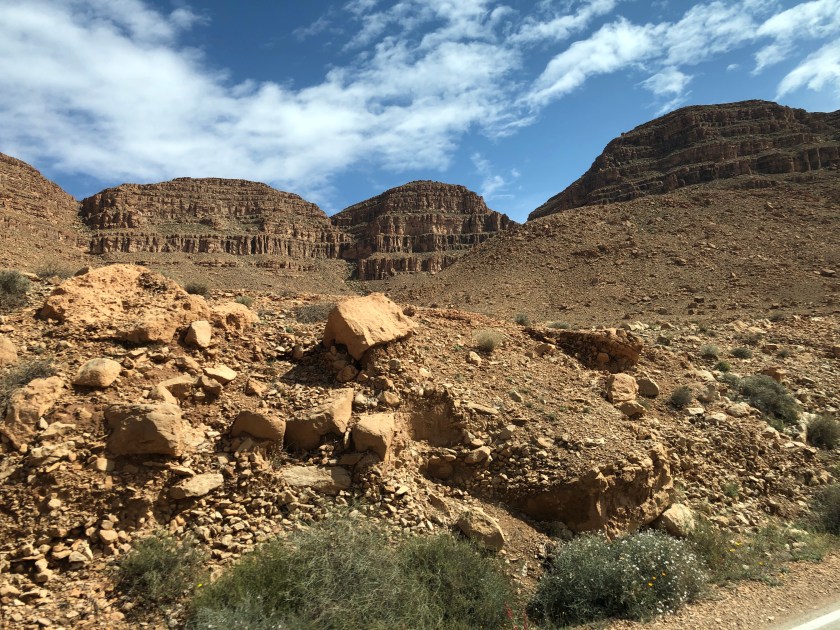
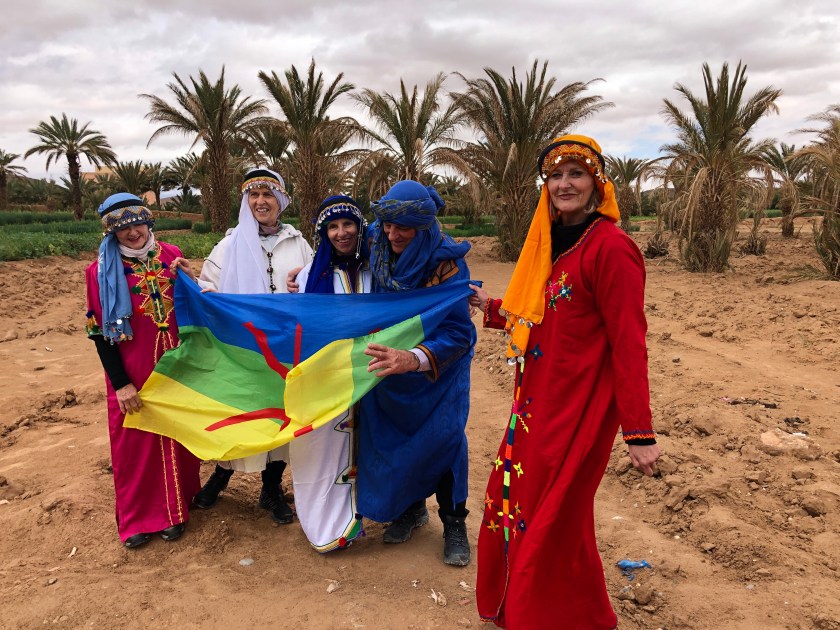
We stopped at a Berber shop where we all got dressed in Berber gear. Unfortunately I had my dress over my clothes and I look a bit like a pregnant midget! We all loved the head dresses though. we posed with the Berber flag which symbolises blue for the sea, green for the land, yellow for the desert, and the Berber symbol which combines the cross of Christianity, Judaism and the crescent for Islam.
We all looked so funny but I looked like a pregnant midget because he dress was over my jacket which has my phone, wallet and camera in the pockets!
When we arrived at our dessert camp we were all thrilled by the tent accommodation. It was so delightful with a little kettle over our hand basin in our personal tent, and an eco toilet, and shower where you had to pump the water. We were greeted with mint tea and biscuits then we went up onto the top of the sand dune to watch the sunset. We all had our heads dressed in traditional headwear which was fun. Then the cameleer came in with the camels and we took a short ride. Mary was very anxious and screamed every time the camel did something more than walk. At one stage she was going Oh! Oh! And I said she sounded like she was having an orgasm. The cameleer thought it was a huge joke! I loved being on a camel again. Ridouane took photos for us. I was on the last camel.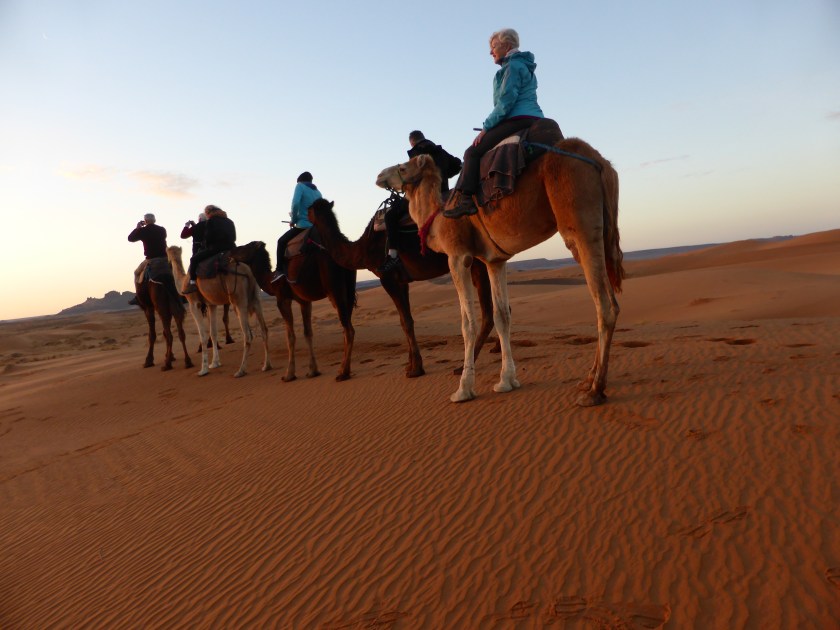
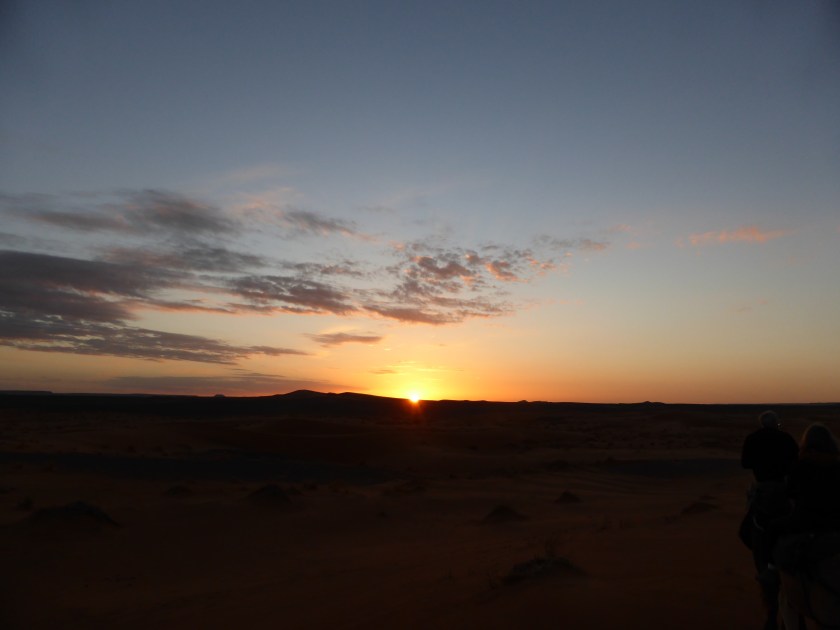
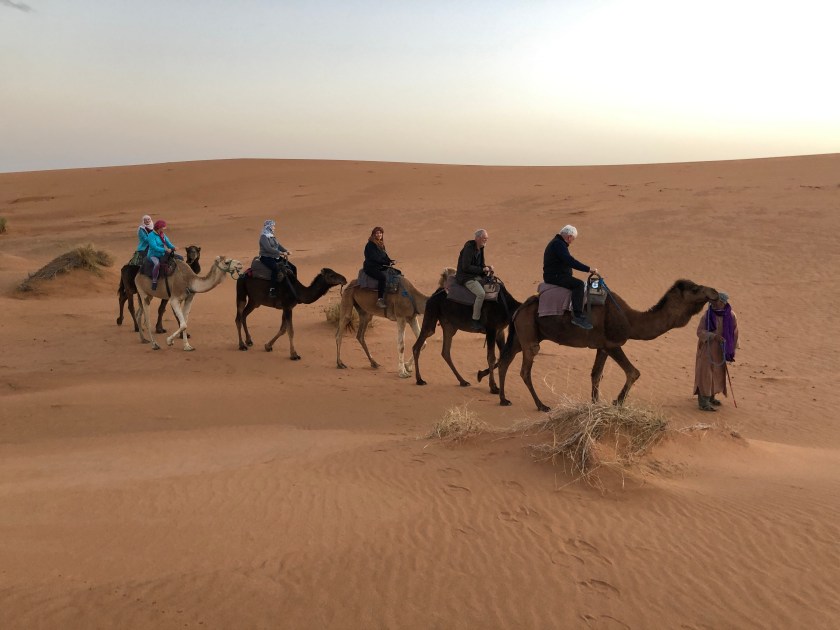
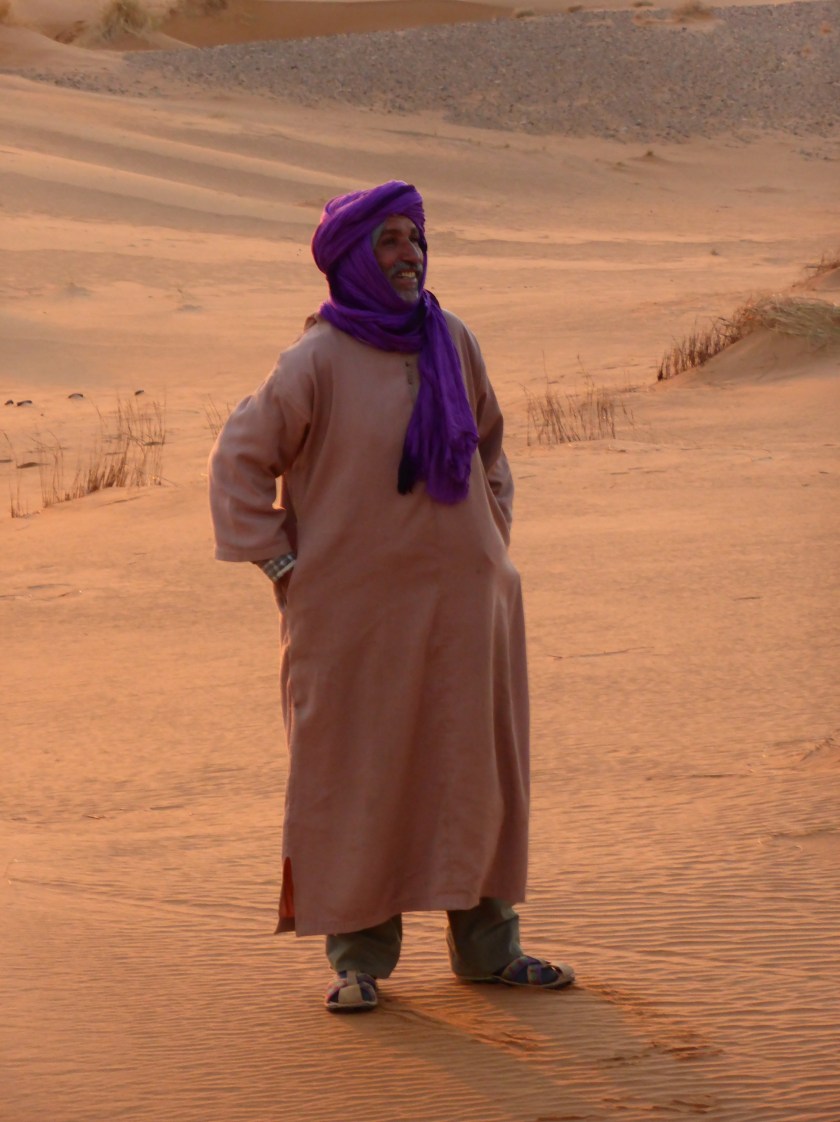
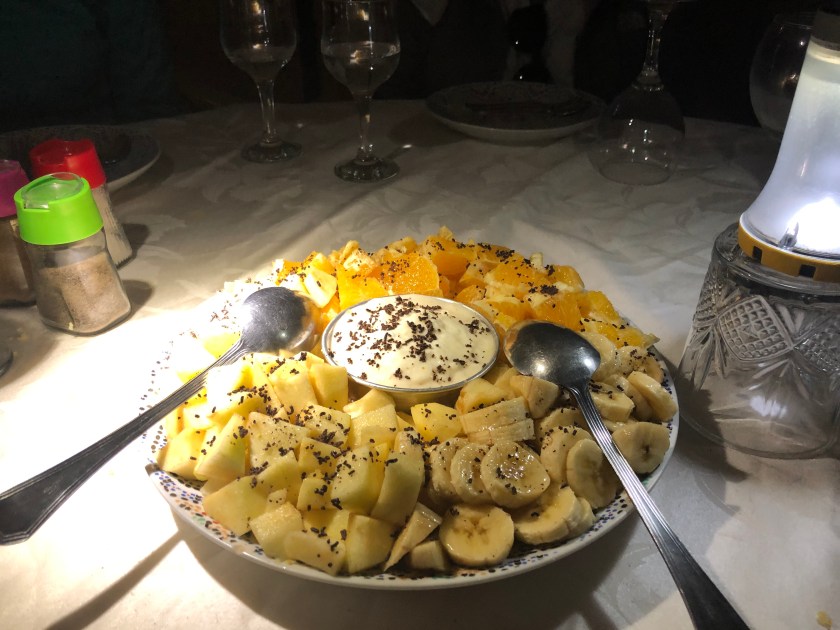
After our ride we went to dinner. The food was fantastic, some of the best we have had. After sitting outside watching the stars it started to get cold so we headed for bed. Jamal the camp captain came to our tent to show us how to zip up the tent for the evening, but we were getting undressed. Anne yelled out ladies dressing and I grabbed a towel for modesty. He just zipped the tent and retreated. The breakfast next morning was fantastic too though we took another camel ride to see the sunrise first. The whole experience was quite magical really. We would all have loved to stay another day.
Fes 31st March
This morning we started the day with a delicious breakfast with pancakes and ricotta and eggs and a range of olives and jams. We are all so impressed with the Riad Marjana. From the outside places look pretty crummy but once past the threshold it is a different story. They are quite spectacular with beautiful tile work, carved and painted ceilings , lacy decorative archways. The furniture is quite bold in colour and pattern but it all works together.
We set off to visit the King’s palace which had been renovated for his daughter’s wedding about 40 odd years ago. As a gift to the people he also invited 200 poor couples to marry at the same time and gave them all 1000 dirhim. He seems to be a very wise and compassionate leader.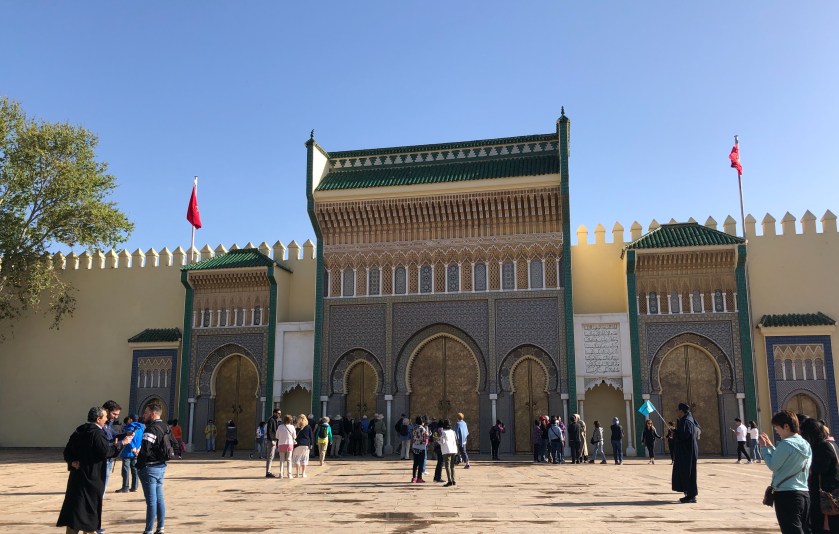
We visited a tile place to see how they make the wonderful mosaics here. Again it is by hand with painstaking chiselling and hand painting. The products were so beautiful I could have bought so many things! I reminded my self that I have downsized!
After the palace we wandered into the old Jewish quarter. This showed all the different types of shops but one caught my eye which had these cream coloured triangular boxes. They are wedding gift boxes. Apparently the groom puts gifts inside the box and gives them to the bride to be.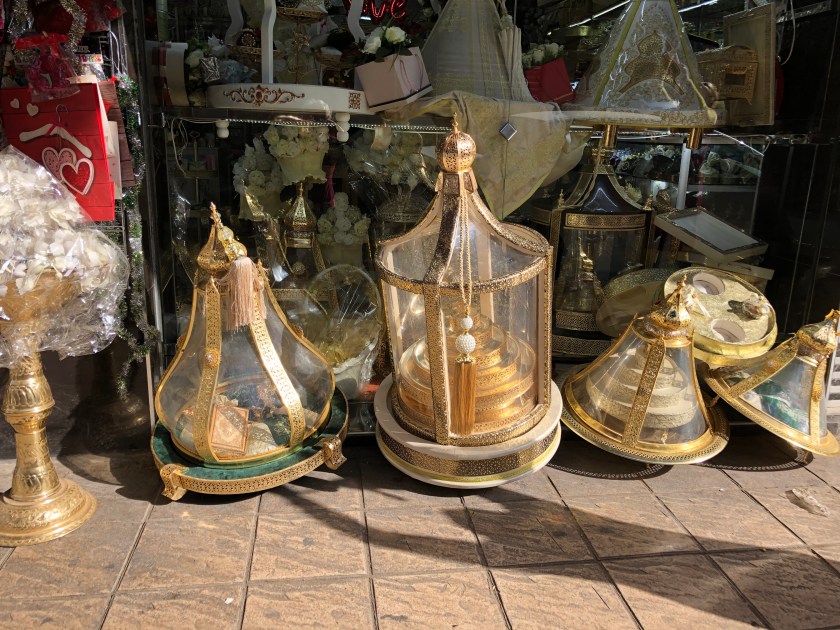
We went up to a vantage point to get an over view before plunging into the Medina. This labyrinthe of shops was so fascinating but I am sure without a guide we would never have seen as much or even found our way out! The lanes were narrow and twisting. We needed to walk single file most of the time. There were donkeys and mules bringing in provisions and people saying Belak, which means move over or get out of the way.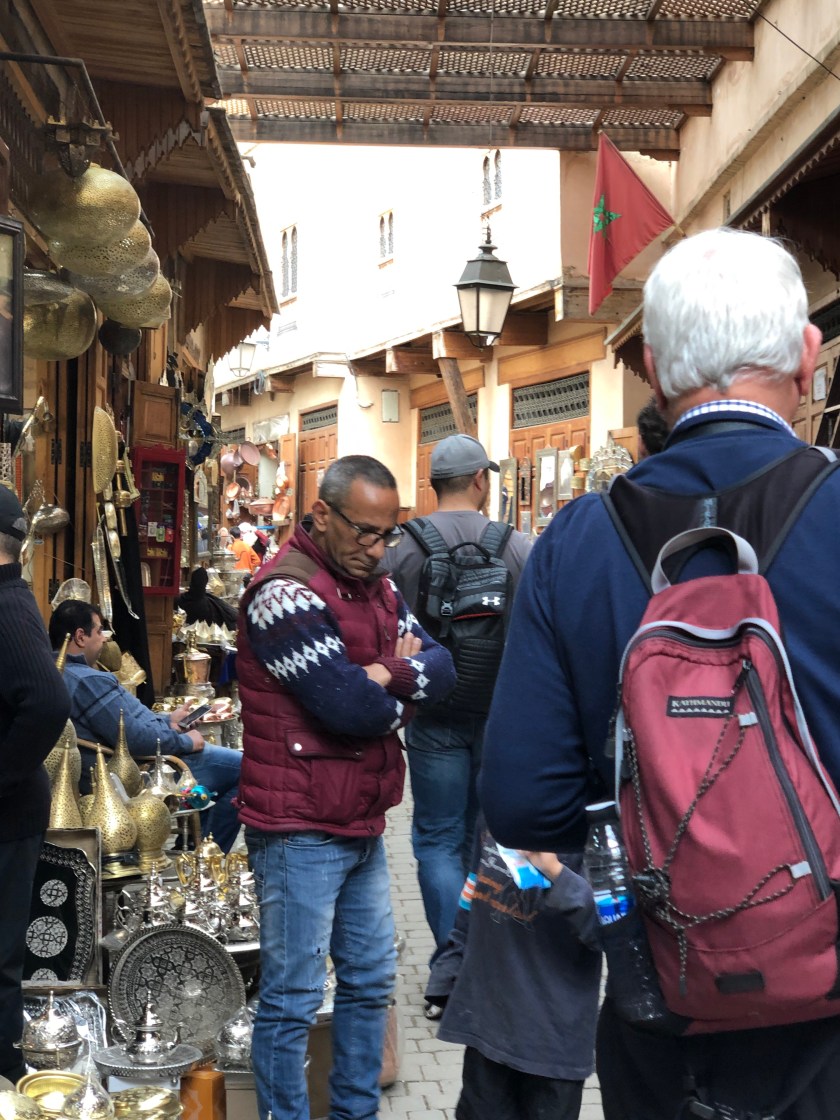
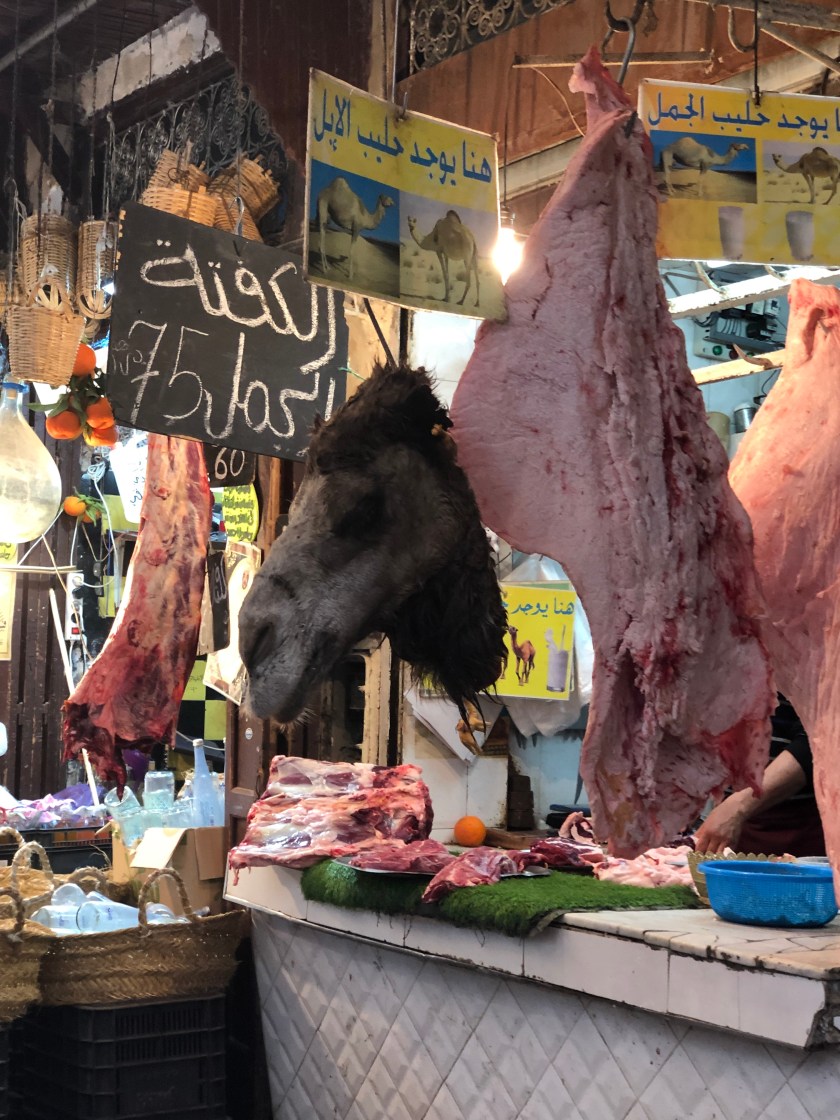
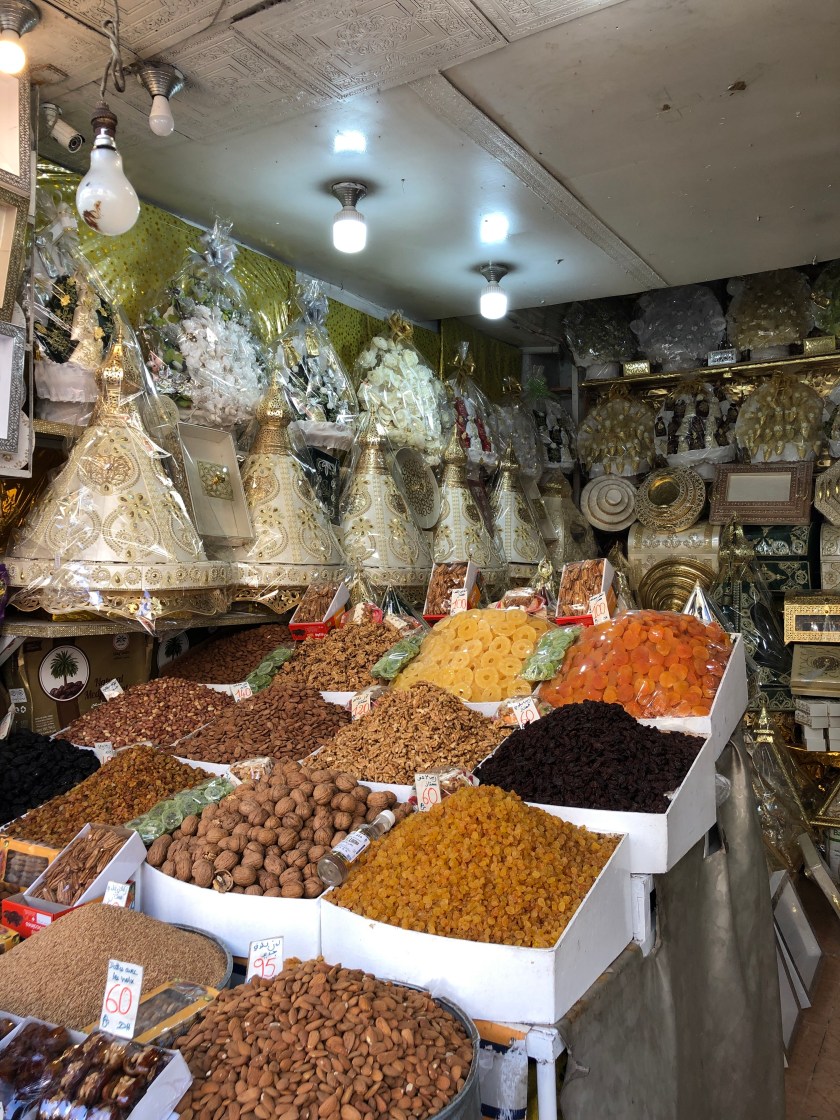
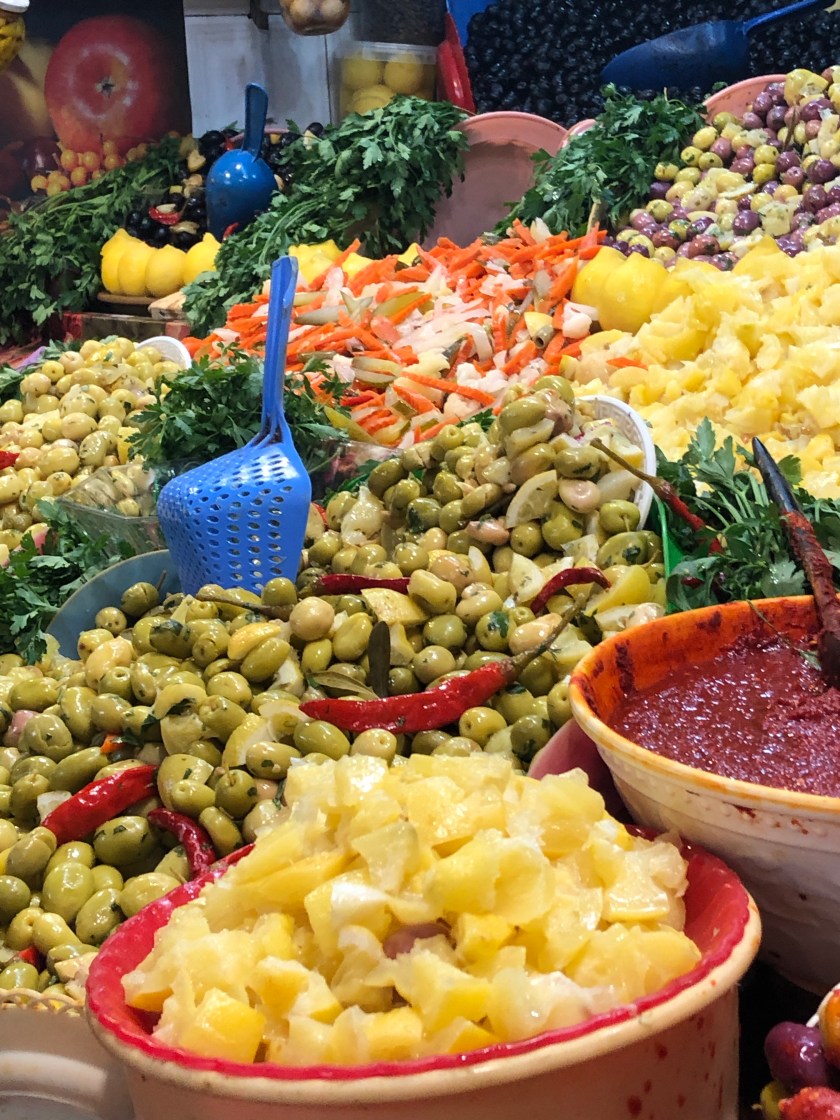
It was fascinating to see the area of colourful food but we always asked if we could take photos. Anne was going to take a photo but the guy who had his hands in a pile of olives just flicked his fingers at her and flicked oil towards her. Most people though are very pleasant. In fact I have been so impressed by the friendliness and good humour of everyone. Everybody knows our guide and they all say shalom or Salam and hug and kiss cheeks or shake hands. No one seems to be in a frantic hurry.
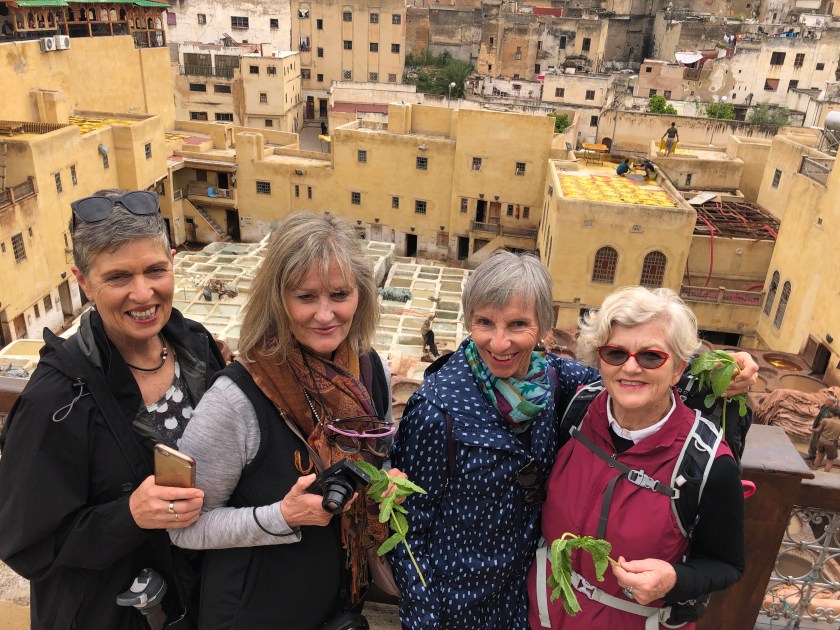
The tanneries are in the Medina and we were all anxious to see the dye wells. We were expecting it to be overpoweringly smelly but it wasn’t. The tannery people gave us mint to hold and crush under our noses but it was barely necessary. Summer might be different. The workers were up to their waist in the vats and we thought they must absorb over time the dyes into their skin. The first vat is the cleaning one and they use protection against the lime and dung used to soak off the fur though they didn’t immerse themselves in those of course. It was a hive of activity rich with all the colours of the rainbow. Naturally we were directed to the shops that bordered the tannery and Mary bought a gorgeous purple leather jacket, Irene a new red backpack and I succumbed to a small but stylish red backpack too. The prices were good and the quality excellent. The array of colours was mind boggling.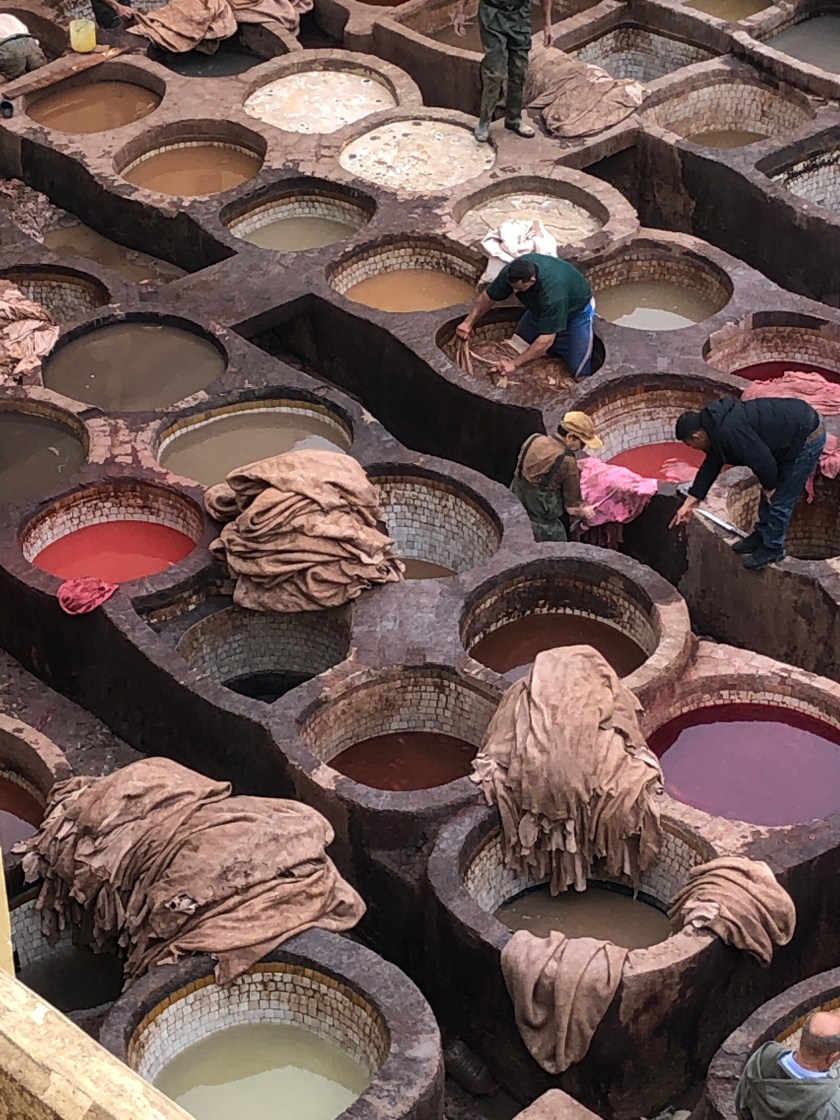
By now we were hungry so our guide took us down a scungey alley to a doorway and inside was a dazzling restaurant where we ate chicken tagine( again) and Moroccan Salad which consists of many little plates of vegetables and dips with bread. We are all putting on weight! People go to so much trouble to prepare food for us that we cannot refuse.
The Medina was full of artisans all using hand tools with no modern technology. Morocco is still in transition from the old ways to the new. Many animals are still used for work and transport.
 fleetfootkath